
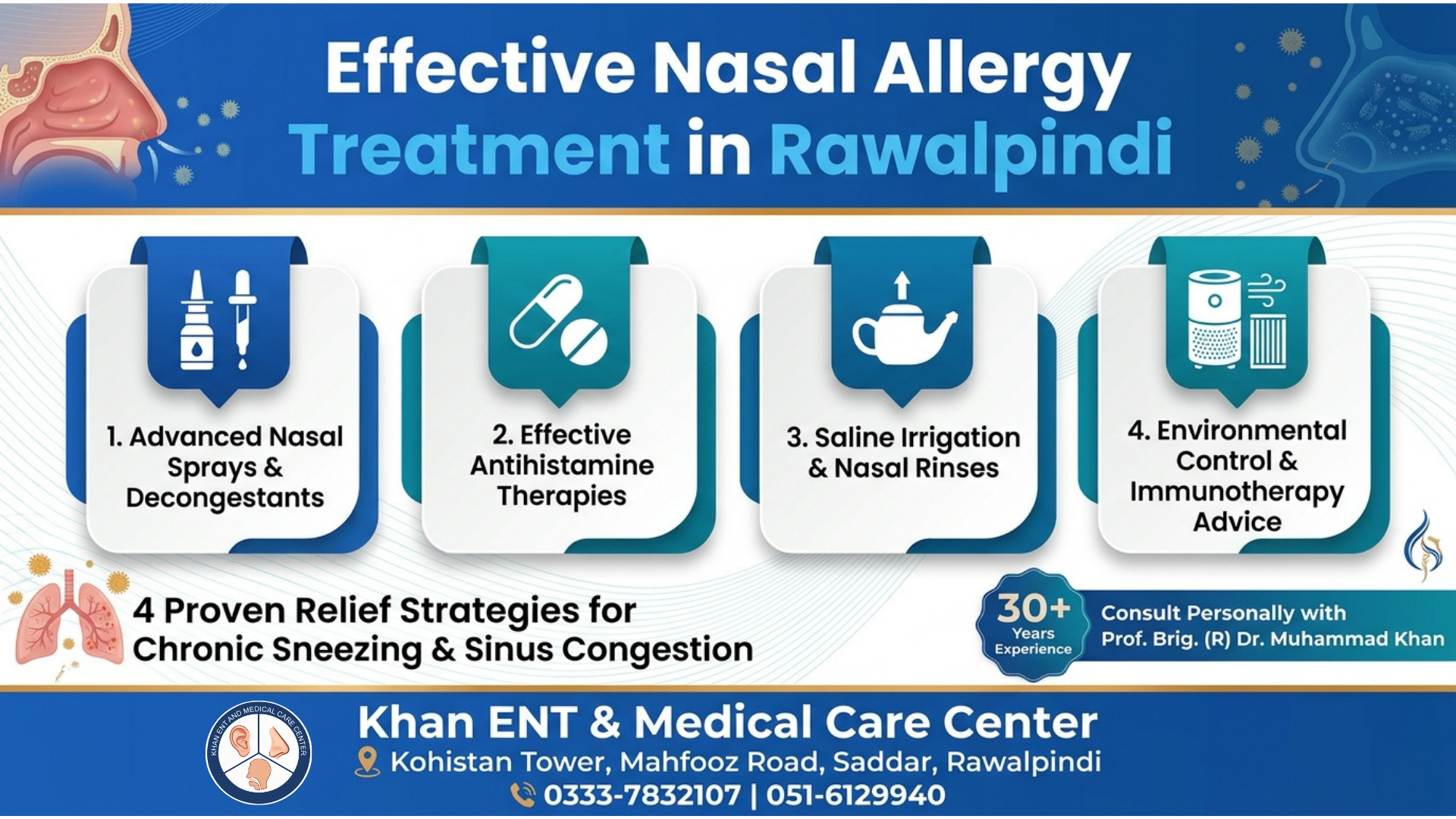
Living with persistent allergic rhinitis, frequent sneezing fits, watery eyes, and chronic sinus congestion can significantly reduce your quality of life. In urban environments like Rawalpindi and Islamabad, high dust levels, seasonal pollen, vehicular emissions, and dry weather often trigger severe nasal reactions. Finding an effective nasal allergy treatment rawalpindi becomes essential for patients seeking lasting relief rather than temporary fixes from over-the-counter antihistamines.
At Khan ENT & Medical Care Center, located at Kohistan Tower in Saddar, Rawalpindi, patients receive specialized diagnostic and therapeutic care directed by Prof. Brig. (R) Dr. Muhammad Khan, a senior Consultant ENT & Head & Neck Surgeon with over 30 years of clinical experience. Selecting a comprehensive nasal allergy treatment rawalpindi under medical supervision ensures that underlying nasal airway obstruction, sinus inflammation, and hypersensitivity are thoroughly evaluated and managed.
Understanding Allergic Rhinitis and Sinus Inflammation
Allergic rhinitis occurs when the immune system overreacts to airborne particles known as allergens. When inhaled, these particles trigger the release of histamine and inflammatory cytokines, causing the nasal lining (mucosa) to swell, produce excess mucus, and block normal airflow.
Common environmental triggers in the twin cities include:
- House Dust Mites: Microscopic organisms thriving in carpets, bedding, and soft furniture.
- Seasonal Pollen: Airborne pollen from trees, grasses, and weeds during spring and autumn transitions.
- Environmental Pollutants: Traffic dust, industrial fumes, and smog commonly present in urban traffic corridors.
- Mold & Fungal Spores: Thriving in damp, poorly ventilated indoor areas or during humid monsoon months.
Without targeted nasal allergy treatment rawalpindi, chronic allergic inflammation can cause nasal turbinate hypertrophy, nasal polyps, Eustachian tube dysfunction, and recurrent sinus infections (sinusitis).
Comprehensive Diagnostic Evaluation and Nasal Endoscopy
The first crucial step in securing effective nasal allergy treatment rawalpindi is obtaining an accurate medical diagnosis. Many patients confuse chronic allergic rhinitis with recurring viral colds or non-allergic sinus conditions, leading to improper self-medication.
A thorough clinical evaluation by an ENT specialist includes:
- Diagnostic Nasal Endoscopy: Inserting a thin, illuminated endoscope into the nasal passages to examine the turbinates, septum, and sinus openings (ostia) in high definition.
- Identification of Structural Blockages: Determining if anatomical issues—such as a deviated nasal septum (DNS) or enlarged turbinates—are compounding your allergy symptoms.
- Symptom Profiling: Differentiating between seasonal allergic rhinitis (triggered at specific times of the year) and perennial allergic rhinitis (year-round exposure to indoor allergens).
Getting an endoscopic examination ensures that your plan for nasal allergy treatment rawalpindi addresses both allergic sensitivity and physical structural blockages.
Targeted Medical Therapy and Inhaled Corticosteroid Sprays
Over-the-counter oral antihistamines can reduce acute itching and sneezing, but they rarely resolve long-term nasal congestion or turbinate swelling. The cornerstone of modern nasal allergy treatment rawalpindi involves evidence-based pharmacotherapy prescribed according to global clinical guidelines (such as ARIA).
Key medical treatments include:
- Intranasal Corticosteroid Sprays: The gold standard for controlling allergic inflammation. Unlike oral steroids, topical nasal sprays act directly on the nasal lining with minimal systemic absorption, shrinking swollen turbinates and clearing blocked airways when used consistently.
- Topical Antihistamine Sprays: Delivering fast-acting localized relief from itching, rhinorrhea (runny nose), and sudden sneezing fits.
- Saline Nasal Irrigation: Utilizing isotonic or hypertonic saline rinses to flush out trapped allergens, dust particles, and thick mucus from the nasal passages, enhancing mucosal healing.
- Leukotriene Receptor Antagonists: Oral medications prescribed in moderate-to-severe cases to block allergic inflammatory pathways, particularly in patients who also experience mild asthma or cough.
Consulting a specialist ensures that your nasal allergy treatment rawalpindi utilizes correct dosage, duration, and proper spray technique to prevent nasal dryness or nosebleeds.
Environmental Trigger Avoidance and Nasal Hygiene
While medical treatments control inflammation, minimizing daily exposure to airborne allergens is vital for long-term symptom management. Combining clinical therapy with aggressive environmental control enhances the success of your nasal allergy treatment rawalpindi.
Recommended environmental controls include:
| Allergen Type | Exposure Control Strategy | Clinical Benefit |
| House Dust Mites | Wash bedding weekly in hot water (>60∘C); use dust-mite-proof mattress covers | Reduces nocturnal nasal congestion and morning sneezing fits |
| Pollen & Outdoor Dust | Keep home and car windows closed during peak pollen hours; wear a mask outdoors | Prevents sudden airborne allergen contact with sensitive nasal mucosa |
| Indoor Mold | Ensure good room ventilation; fix water leaks and clean damp bathroom areas promptly | Prevents fungal spore inhalation that triggers chronic sinus pressure |
| Dry Air & Pollution | Use room humidifiers and perform daily saline nasal rinses after returning indoors | Keeps nasal mucosa moist and flushes out daily atmospheric pollutants |
Integrating these habits alongside professional nasal allergy treatment rawalpindi provides continuous defense against seasonal flare-ups.
Advanced Surgical Management for Obstructive Complications
In cases where chronic allergic rhinitis has persisted for years without treatment, the nasal lining can undergo permanent structural enlargement (chronic inferior turbinate hypertrophy), or benign growths (nasal polyps) may develop. When medical management alone cannot restore clear breathing, surgical intervention may be recommended as part of your comprehensive nasal allergy treatment rawalpindi.
Minimally invasive options offered by an experienced ENT surgeon include:
- Radiofrequency / Submucosal Turbinate Reduction: A short procedure to shrink enlarged turbinates while preserving functional mucosal tissue, rapidly restoring normal nasal airflow.
- Functional Endoscopic Sinus Surgery (FESS): Removing nasal polyps and opening blocked sinus drainage pathways under direct endoscopic visualization.
- Septoplasty: Correcting a deviated nasal septum to balance air distribution across both nasal cavities and improve the delivery of topical nasal sprays.
Undergoing a surgical evaluation at an established center ensures that structural barriers to your nasal allergy treatment rawalpindi are safely resolved.
Why Choose Khan ENT & Medical Care Center?
Managing persistent sinus pressure and sneezing requires experienced clinical care. At Khan ENT & Medical Care Center, patients seeking nasal allergy treatment rawalpindi benefit from:
- Senior Surgical Leadership: Direct consultation with Prof. Brig. (R) Dr. Muhammad Khan, Consultant ENT & Head & Neck Surgeon with 30+ years of clinical and surgical expertise.
- Barrier-Free Ground Floor Access: Located at Ground Floor, Kohistan Tower, Saddar, Rawalpindi—providing 100% step-free street entrance without elevator delays.
- Complete ENT & Sinus Care: Diagnostic nasal endoscopy, allergy management, micro-suction ear care, and specialized head and neck care under one roof.
Frequently Asked Questions
What is the difference between a common cold and a nasal allergy?
A cold is caused by a viral infection and usually resolves within 7 to 10 days, often accompanied by body aches or low fever. A nasal allergy (allergic rhinitis) causes clear, watery nasal discharge, intense itching, and sneezing fits that persist for weeks or months as long as you are exposed to the trigger.
Are nasal allergy sprays safe to use long-term?
Steroid nasal sprays prescribed by an ENT specialist for nasal allergy treatment rawalpindi are extremely safe for long-term use because they act locally inside the nose with minimal systemic absorption. However, over-the-counter decongestant sprays (like oxymetazoline) should not be used for more than 3 to 5 consecutive days to avoid severe rebound congestion (rhinitis medicamentosa).
Can nasal allergies lead to sinus infections?
Yes. Severe allergic swelling blocks the narrow drainage channels of your sinuses. Trapped mucus becomes a breeding ground for bacteria, turning a simple nasal allergy into painful acute or chronic sinusitis.
What are the clinic operating hours?
Our clinic is open for consultations and procedures from Monday through Saturday. Please note that the clinic is closed every Sunday.
Book Your Allergy Consultation Today
Stop letting chronic sneezing, runny nose, and sinus pressure dictate your daily life. To get effective, expert-guided nasal allergy treatment rawalpindi tailored to your needs, visit our accessible ground-floor practice in Saddar today.
Clinical Lead: Prof. Brig. (R) Dr. Muhammad Khan
Consultant ENT | Head & Neck Surgeon (30+ Years Clinical Expertise)
Khan ENT & Medical Care Center
Ground Floor, Kohistan Tower, Mahfooz Road, Opposite AFIC, Saddar, Rawalpindi
Book Your Consultation: 0333-7832107 | 0333-8898980 | 051-6129940