
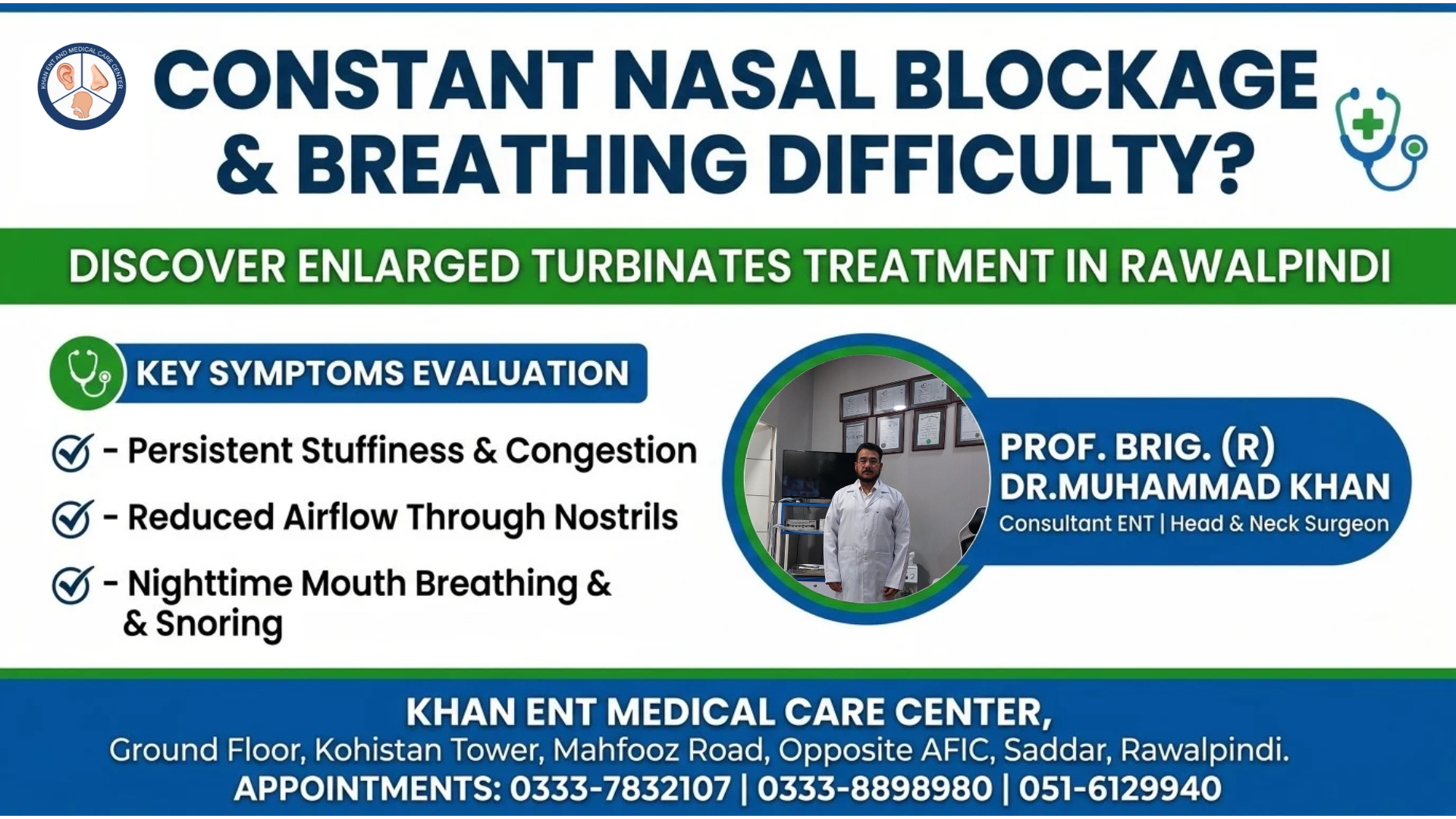
Persistent nasal congestion, difficulty breathing through the nose, and nighttime mouth breathing are common complaints that significantly impact daily comfort and sleep quality. While many individuals attribute chronic nasal blockage to simple seasonal allergies, the underlying cause is often structural swelling inside the nasal passages known as turbinate hypertrophy. Accessing specialized enlarged turbinates treatment in Rawalpindi allows patients to pinpoint the precise anatomical cause of airflow restriction and restore effortless nasal breathing.
Nasal turbinates are bony, shelf-like structures lined with soft mucosal tissue located inside the lateral walls of the nasal cavity. Their primary function is to warm, humidify, and filter the air you inhale. However, when these mucosal linings become chronically inflamed or enlarged due to environmental allergies, sinus infections, or anatomical deviations, they narrow the internal airway. Seeking timely enlarged turbinates treatment in Rawalpindi prevents chronic nasal obstruction from leading to long-term sinus complications and sleep disruption.
Understanding Turbinate Hypertrophy and Airway Obstruction
When nasal turbinates particularly the inferior turbinates become swollen, they create physical resistance to incoming air. This forces individuals to rely on mouth breathing, which bypasses the natural humidification system of the respiratory tract.
| Clinical Aspects of Inferior Turbinate Enlargement | Healthy Nasal Passages | Hypertrophic Nasal Turbinates |
| Airflow Resistance | Smooth, low-resistance respiration | High physical resistance & chronic stuffiness |
| Mucosal Swelling | Regulated, normal mucosal volume | Chronically engorged soft tissues |
| Breathing Pattern | Natural, restful nasal respiration | Forced mouth breathing & sleep disruption |
| Impact on Sleep | Deep, continuous REM sleep | Frequent nighttime waking & loud snoring |
By obtaining a comprehensive evaluation for enlarged turbinates treatment in Rawalpindi, patients receive a clear diagnosis and a targeted management plan designed to reopen blocked nasal corridors.
Key Causes of Swollen Nasal Turbinates
Inferior turbinate enlargement develops from various inflammatory and anatomical triggers. Identifying these factors is essential when structuring an effective strategy for enlarged turbinates treatment in Rawalpindi:
Chronic Allergic Rhinitis
Environmental allergens such as pollen, dust mites, mold, and pet dander cause persistent mucosal inflammation, leading to long-term enlargement of the turbinate tissue.
Non-Allergic Rhinitis
Temperature shifts, atmospheric dust, chemical fumes, and hormonal fluctuations can trigger vasomotor changes that swell nasal turbinates even without an allergic reaction.
Chronically swollen nasal turbinates severely restrict airflow, leading to persistent nasal blockage, snoring, and reduced oxygen intake during sleep.
Deviated Nasal Septum (Compensatory Hypertrophy)
When the nasal septum is crooked, the turbinate on the wider side of the nasal cavity often enlarges to compensate for the unequal airflow, resulting in bilateral obstruction.
Overuse of Decongestant Nasal Sprays (Rhinitis Medicamentosa)
Rebound congestion caused by the prolonged use of over-the-counter decongestant sprays leads to severe, drug-induced swelling that requires expert enlarged turbinates treatment in Rawalpindi to resolve safely.
Modern Diagnostic Approaches
Accurate diagnosis is the cornerstone of successful therapy. Before initiating enlarged turbinates treatment in Rawalpindi, a comprehensive clinical assessment is performed to evaluate the exact extent of tissue hypertrophy:
- In-Clinic Video Nasal Endoscopy: A thin endoscopic instrument provides high-definition visual examination of internal nasal passages, identifying tissue volume, septal alignment, and mucosal health.
- Decongestant Response Testing: Evaluates whether swollen mucosal tissue shrinks in response to topical agents, helping determine whether medical or surgical intervention is required.
- CT Sinus Scanning: Provides detailed imaging to rule out coexisting nasal polyps, sinus infections, or deep structural anomalies.
Undergoing a complete diagnostic evaluation ensures that your enlarged turbinates treatment in Rawalpindi targets the exact cause of your breathing difficulties.
5 Proven Solutions for Enlarged Turbinates Treatment in Rawalpindi
Depending on whether the enlargement is mucosal or structural, treatment strategies range from targeted medical regimens to minimally invasive daycare procedures.
Solution 1: Targeted Topical Steroid & Antihistamine Sprays
Prescription corticosteroid nasal sprays reduce mucosal inflammation and shrink swollen turbinate tissue over time. When combined with non-sedating antihistamines, this form of medical enlarged turbinates treatment in Rawalpindi controls allergen-driven swelling effectively.
Solution 2: Saline Nasal Irrigations & Environmental Control
Regular isotonic or hypertonic saline rinses flush away allergens, irritants, and excess mucus, soothing the turbinate mucosa and enhancing the efficacy of prescribed nasal sprays.
Solution 3: Radiofrequency Turbinate Reduction (RFTR)
When medications fail to provide lasting relief, Radiofrequency Turbinate Reduction offers a modern, minimally invasive solution. This procedure uses controlled thermal energy to shrink underlying turbinate tissue while preserving the mucosal surface, providing long-term relief through advanced enlarged turbinates treatment in Rawalpindi.
| Treatment Modality | Primary Mechanism | Patient Suitability |
| Medical Therapy | Anti-inflammatory sprays & antihistamines | Mild to moderate allergic swelling |
| Radiofrequency Reduction | Internal submucosal tissue shrinkage | Moderate, persistent enlargement |
| Submucosal Resection | Partial removal of underlying bone | Severe, chronic osseous hypertrophy |
Solution 4: Submucosal Resection (SMR) with Microdebrider
For cases involving both bony expansion and soft tissue hypertrophy, submucosal resection reduces the bony core while shaving excess tissue, widening the nasal pathway without disturbing natural mucosal function.
Solution 5: Combined Septoplasty and Turbinate Surgery
When turbinate enlargement is accompanied by a severe septal deviation, performing a septoplasty alongside turbinate reduction ensures complete restoration of nasal patency. Selecting comprehensive enlarged turbinates treatment in Rawalpindi addresses both structural and soft tissue blockages in a single setting.
Long-Term Benefits of Addressing Swollen Turbinates
Seeking specialized enlarged turbinates treatment in Rawalpindi offers immediate and long-lasting health benefits:
- Unobstructed Nasal Breathing: Restores effortless airflow through both nostrils day and night.
- Improved Sleep Quality & Snoring Reduction: Eliminates forced mouth breathing, reducing palatal vibration and nighttime awakenings.
- Enhanced Sinus Drainage: Reduces the frequency of recurrent sinus infections and facial pressure.
- Better Exercise Tolerance: Allows optimal oxygen intake during physical activity and exertion.
Patients who undergo tailored enlarged turbinates treatment in Rawalpindi experience significant improvements in daily vitality and overall quality of life.
Frequently Asked Questions (FAQs)
What are nasal turbinates and what is their function?
Nasal turbinates are structures on the side walls of the nasal cavity that warm, humidify, and filter the air you breathe before it reaches your lungs.
What causes nasal turbinates to become enlarged?
Turbinates enlarge due to chronic allergies, environmental irritants, sinus infections, septal deviations, or overuse of decongestant nasal sprays.
Can enlarged turbinates cause snoring?
Yes. Swollen turbinates block nasal airflow, forcing you to breathe through your mouth while sleeping, which increases soft tissue vibration and snoring.
How do I know if I need medical or surgical enlarged turbinates treatment in Rawalpindi?
An ENT specialist performs a video nasal endoscopy to evaluate whether the swelling is mucosal (treated medically) or structural/bony (requiring minor procedure).
Is Radiofrequency Turbinate Reduction a painful procedure?
No. Radiofrequency turbinate reduction is performed under local anesthesia in a day-care setting, making it comfortable and virtually painless.
Will shrinking my turbinates affect my ability to smell?
Properly performed submucosal reduction preserves the outer mucosal layer, maintaining both normal nasal function and your sense of smell.
How long does recovery take after minor turbinate reduction surgery?
Most patients resume normal non-strenuous activities within 2 to 4 days, with full healing and optimal breathing achieved within 2 to 3 weeks.
Can enlarged turbinates return after treatment?
While radiofrequency reduction provides long-lasting results, managing underlying allergies with sprays or rinses helps prevent mucosal swelling from recurring.
What is the danger of using decongestant nasal sprays for too long?
Using over-the-counter decongestant sprays for more than 3 to 5 days causes rebound swelling (rhinitis medicamentosa), making turbinate enlargement worse.
Where can I consult a specialist for enlarged turbinates treatment in Rawalpindi?
Prof. Brig. (R) Dr. Muhammad Khan provides comprehensive endoscopic evaluation and advanced care at Khan ENT & Medical Care Center in Saddar, Rawalpindi.
Living with constant nasal congestion and breathing difficulty is unnecessary. By seeking expert enlarged turbinates treatment in Rawalpindi, you can uncover the exact cause of your nasal obstruction and receive targeted medical or minimally invasive care. Restoring clear nasal pathways leads to better sleep, improved oxygen intake, and enhanced overall health.
If chronic nasal blockage is affecting your daily comfort, scheduling an evaluation for enlarged turbinates treatment in Rawalpindi is the first step toward lasting relief.
Consultation & Contact Details
Prof. Brig. (R) Dr. Muhammad Khan
Consultant ENT | Head & Neck Surgeon
30+ Years of Senior Military & Civilian Surgical Expertise
Khan ENT & Medical Care Center
Ground Floor, Kohistan Tower, Mahfooz Road, Opposite AFIC, Saddar, Rawalpindi
Phone / WhatsApp: 0333-7832107 | 0333-8898980 | 051-6129940