
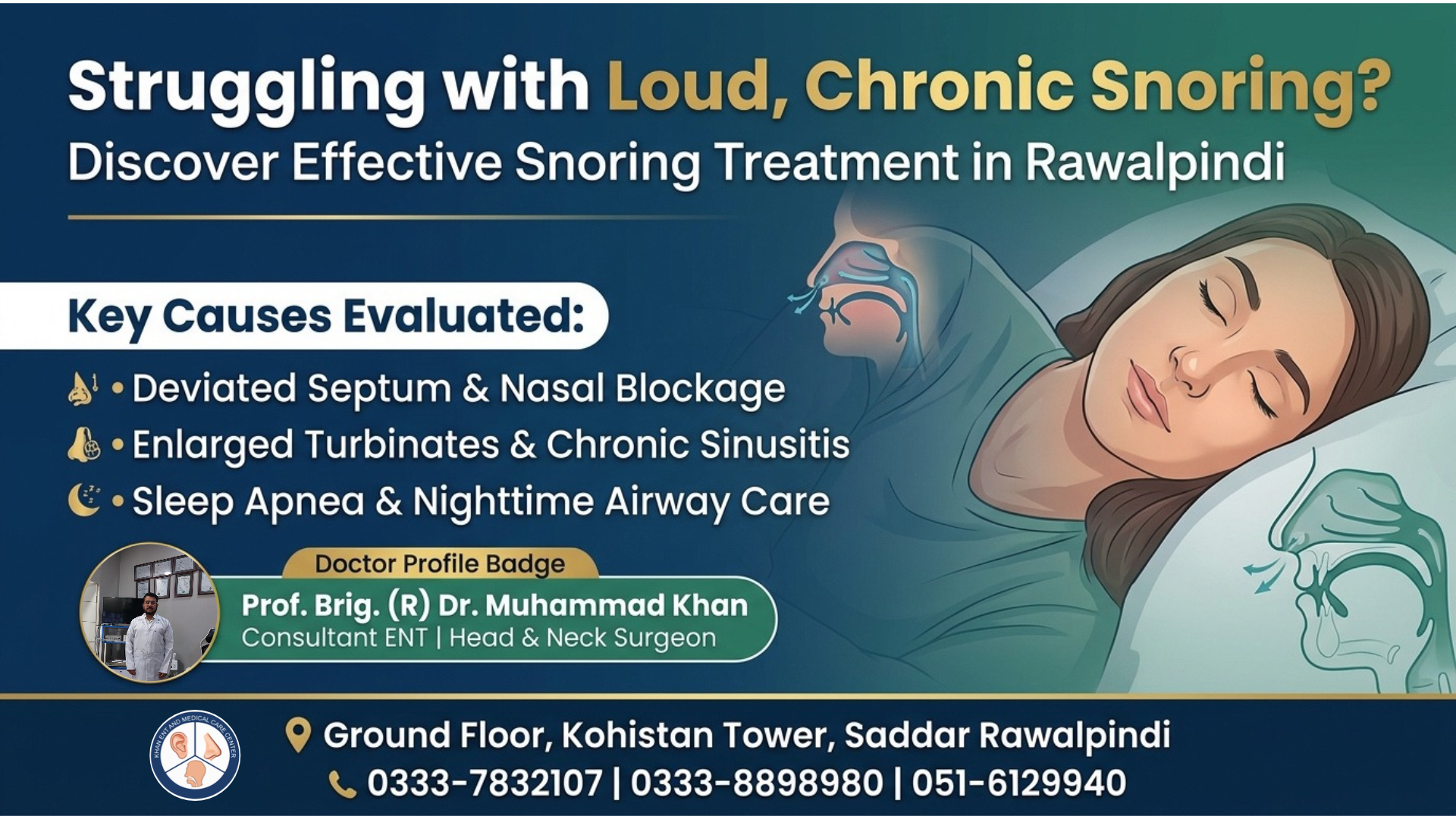
Loud, disruptive snoring is often dismissed as a harmless habit or a minor nighttime nuisance. However, chronic snoring frequently signals underlying physical obstructions within the nasal passages or upper airway. When nighttime breathing is restricted, oxygen levels drop, sleep quality deteriorates, and long-term health risks increase. Seeking professional snoring treatment in Rawalpindi helps individuals identify the root physical causes of airway blockage and restore quiet, restful sleep.
Understanding the mechanics of snoring is the first step toward effective relief. When airflow through the nose and throat is physically restricted, surrounding soft tissues vibrate intensely as air passes through narrowed channels. Seeking timely snoring treatment in Rawalpindi ensures that structural issues such as nasal polyps, severe septal deviation, or enlarged turbinates are accurately evaluated by an experienced ear, nose, and throat (ENT) specialist.
Why Chronic Snoring Is More Than Just a Noise Problem
Many people assume snoring originates solely in the throat or soft palate. In reality, the nasal cavity acts as the primary gateway for upper airway respiration. When nasal breathing is impaired, forcing individuals to mouth-breathe during sleep, the soft tissues in the back of the throat collapse backward much more easily.
| Nasal Breathing vs. Mouth Breathing During Sleep | Nasal Respiration | Mouth Respiration |
| Airflow Resistance | Low, regulated resistance | High airway collapse risk |
| Tissue Vibration | Minimal soft tissue movement | Intense palatal vibration |
| Oxygen Saturation | Optimal oxygen delivery | Reduced sleep depth & apnea risks |
| Long-Term Impact | Restful, uninterrupted sleep | Daytime fatigue & chronic exhaustion |
By receiving specialized snoring treatment in Rawalpindi, patients can address nasal obstructions directly, allowing natural, quiet nasal respiration during sleep.
Common ENT Causes of Chronic Snoring
A thorough clinical assessment reveals that chronic snoring typically stems from one or more structural abnormalities inside the upper airway:
Deviated Nasal Septum (DNS)
A crooked or displaced nasal septum restricts airflow through one or both nostrils. This chronic restriction forces mouth-breathing during sleep, directly triggering loud palatal snoring.
Nasal Polyps and Chronic Sinusitis
Inflammatory mucosal growths (nasal polyps) block sinus drainage ports and upper nasal passages. Patients seeking snoring treatment in Rawalpindi often discover that unmanaged sinus inflammation is the primary driver of their nighttime breathing difficulties.
Restricted nasal airflow forces nighttime mouth-breathing, significantly increasing tissue vibration and airway collapse during deep sleep.
Turbinate Hypertrophy
Swollen or enlarged nasal turbinates narrow the internal nasal valve. Allergy-induced turbinate swelling severely impedes nighttime nasal ventilation.
Obstructive Sleep Apnea (OSA)
When airway collapse causes temporary breathing pauses accompanied by gasping or choking during sleep, chronic snoring evolves into Obstructive Sleep Apnea. Accessing modern snoring treatment in Rawalpindi prevents sleep apnea from worsening over time.
Modern Diagnostic Approaches for Snoring
Accurate diagnosis determines whether medical therapy, lifestyle adjustments, or minor corrective surgery will provide the best clinical outcome.
Individuals pursuing snoring treatment in Rawalpindi undergo comprehensive clinical evaluations:
- In-Clinic Video Nasal Endoscopy: A ultra-thin endoscopic camera provides high-definition visual assessment of internal nasal structures, septal alignment, and turbinate sizing.
- Airway Cross-Sectional Analysis: Evaluates the degree of pharyngeal and nasal occlusion during inspiration.
- Diagnostic Imaging (CT Sinus): Detailed 3D imaging maps the paranasal sinuses to check for deeper anatomical obstructions.
Receiving a complete diagnostic workup ensures that your snoring treatment in Rawalpindi targets the exact anatomical location causing airway resistance.
Medical and Non-Surgical Treatment Options
For early-stage or allergy-driven nasal blockage, non-surgical interventions offer significant relief.
Initial stages of snoring treatment in Rawalpindi frequently involve:
- Targeted Nasal Sprays & Antihistamines: Reduces allergic mucosal swelling and opens congested nasal passages.
- Continuous Saline Irrigations: Clears thick mucus, environmental irritants, and inflammatory markers from sinus cavities.
- Positional Sleep Therapy & Weight Management: Helps reduce throat tissue compression during deep sleep cycles.
When conservative medical management fails to clear severe physical blockages, consulting a specialist for surgical snoring treatment in Rawalpindi becomes necessary.
Minimally Invasive Surgical Solutions
When physical obstructions like large polyps or a crooked septum prevent normal airflow, minimally invasive day-care procedures offer definitive, scar-free solutions:
| Procedure | Clinical Purpose | Approach |
| Septoplasty | Straightens crooked nasal septum | 100% internal incision |
| Functional Endoscopic Sinus Surgery (FESS) | Clears nasal polyps & opens sinus pathways | Micro-instrument endoscopic care |
| Turbinate Reduction | Shrinks enlarged turbinate tissue | Radiofrequency or minor reduction |
Choosing advanced surgical snoring treatment in Rawalpindi restores physiological nasal airflow, eliminates forced mouth-breathing, and significantly reduces snoring intensity.
Long-Term Benefits of Treating Snoring
Investing in professional snoring treatment in Rawalpindi produces immediate improvements in overall quality of life:
- Restored Sleep Quality: Eliminates frequent nighttime micro-awakenings and restores deep REM sleep.
- Improved Daytime Energy: Eliminates morning headaches, daytime drowsiness, and chronic brain fog.
- Enhanced Cardiovascular Health: Maintaining continuous oxygenation during sleep reduces strain on the heart and vascular system.
- Better Partner Sleep: Quieting loud snoring restores peaceful sleep for family members and bed partners.
Patients who complete customized snoring treatment in Rawalpindi enjoy sustained physical health and daily vitality.
Frequently Asked Questions (FAQs)
Is snoring always caused by a nose problem?
Not always, but nasal obstruction is one of the most common contributing factors. When nasal passages are blocked, forced mouth-breathing causes the throat tissues to vibrate loudly.
How do I know if my snoring requires medical evaluation?
You should seek medical evaluation if your snoring is loud enough to disturb others, accompanied by gasping or choking at night, or causes morning headaches and daytime fatigue.
Can a deviated nasal septum cause loud snoring?
Yes. A deviated septum blocks normal airflow through the nostrils, forcing you to breathe through your mouth while sleeping, which triggers palatal vibration and snoring.
What is the difference between simple snoring and Obstructive Sleep Apnea (OSA)?
Simple snoring is the sound of vibrating upper airway tissue. Sleep apnea occurs when the airway becomes completely blocked, causing temporary pauses in breathing and dropping blood oxygen levels.
What non-surgical solutions are available for snoring?
Non-surgical options include prescription nasal sprays, allergy management, saline rinses, weight loss, and oral sleep appliances.
Will sinus surgery or FESS cure my snoring?
If your snoring is caused by nasal polyps, chronic sinus blockage, or turbinate swelling, clearing these obstructions with FESS or septoplasty can eliminate or drastically reduce snoring.
Is video nasal endoscopy painful during a snoring consultation?
No. Diagnostic video nasal endoscopy is performed using a mild topical numbing spray, making the brief examination comfortable and pain-free.
How long does recovery take after minor nasal surgery for snoring?
Most patients return to light work and daily activities within 5 to 7 days, with full mucosal healing occurring over 3 to 4 weeks.
Can children suffer from chronic snoring due to ENT issues?
Yes. Children frequently snore due to enlarged tonsils, swollen adenoids, or nasal allergies, which can affect their sleep, growth, and school performance.
Where can I get specialized snoring treatment in Rawalpindi?
At Khan ENT & Medical Care Center in Saddar, Rawalpindi, Prof. Brig. (R) Dr. Muhammad Khan provides comprehensive diagnostic endoscopy and advanced care for chronic snoring and nasal airway obstruction.
Loud, persistent snoring should never be ignored. By seeking specialized snoring treatment in Rawalpindi, patients can identify the underlying cause of their upper airway obstruction and access proven medical or surgical treatments. Restoring natural nasal breathing leads to deeper sleep, better daytime energy, and overall long-term health.
If chronic snoring is affecting your rest and daily well-being, scheduling a comprehensive clinical evaluation for snoring treatment in Rawalpindi is the first step toward lasting relief.
Consultation & Contact Details
Prof. Brig. (R) Dr. Muhammad Khan
Consultant ENT | Head & Neck Surgeon
30+ Years of Senior Military & Civilian Surgical Expertise
Khan ENT & Medical Care Center
Ground Floor, Kohistan Tower, Mahfooz Road, Opposite AFIC, Saddar, Rawalpindi
Phone / WhatsApp: 0333-7832107 | 0333-8898980 | 051-6129940