
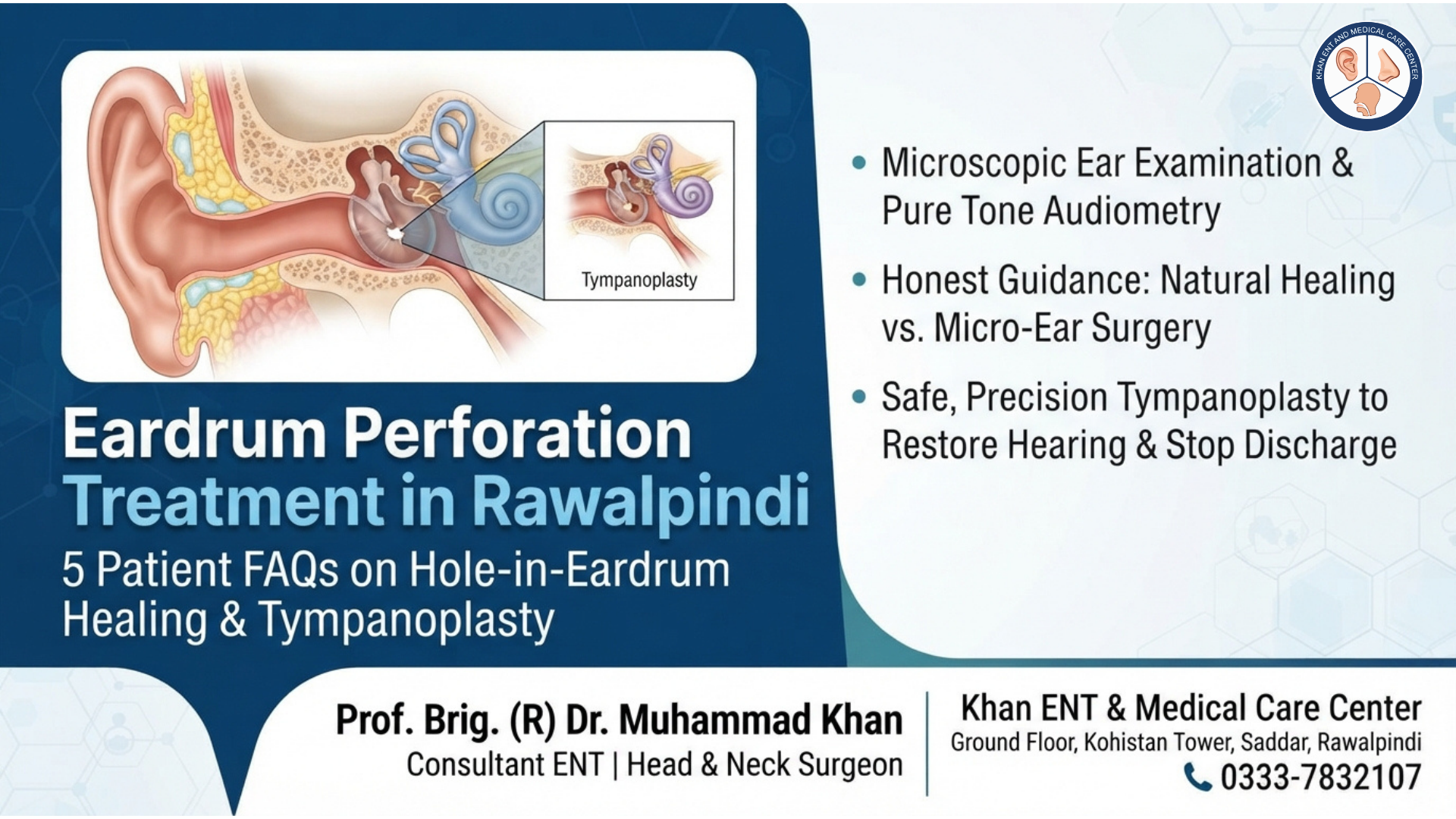
Being told you have a "hole in the eardrum" medically known as a tympanic membrane perforation often raises immediate questions about permanent hearing loss, recurring ear infections, and whether ear surgery is unavoidable. Because your eardrum acts as both a delicate sound-vibrating membrane and a protective seal keeping water and bacteria out of the middle ear, seeking accurate eardrum perforation treatment rawalpindi is essential to protect both your hearing and long-term ear health.
At Khan ENT & Medical Care Center on the ground floor of Kohistan Tower in Saddar, Rawalpindi, Prof. Brig. (R) Dr. Muhammad Khan brings over 30 years of senior consultant experience in ENT and Micro-Ear Surgery to patients with acute and chronic eardrum perforations. Rather than rushing every patient into the operating room or leaving a chronic perforation untreated until hearing worsens proper eardrum perforation treatment rawalpindi begins with microscopic ear visualization, objective hearing testing, and honest guidance on natural healing versus surgical repair (tympanoplasty). Below, we answer the five most common questions patients ask when exploring eardrum perforation treatment rawalpindi.
What Causes an Eardrum Perforation?
Before reviewing your treatment options, it helps to understand how a perforation develops in the first place.
A hole in the tympanic membrane typically arises from one of four everyday triggers:
- Untreated or Recurrent Middle Ear Infections (Otitis Media): Fluid and pus build up behind the eardrum during a severe cold, sinus infection, or childhood ear infection, creating pressure until the membrane ruptures to release the fluid.
- Cotton Buds & Foreign Objects: Inserting cotton swabs, hairpins, or matchsticks into the ear canal is one of the most frequent causes of sudden traumatic eardrum tears.
- Sudden Pressure Changes or Acoustic Blast Trauma: A sharp slap over the ear, diving underwater, rapid air pressure shifts, or an intense nearby explosion can tear the thin eardrum tissue.
- Chronic Suppurative Otitis Media (CSOM): Long-standing middle ear inflammation that prevents a small hole from closing naturally, leading to intermittent watery or pus-like ear discharge whenever water enters the ear or a throat infection occurs.
5 Essential Patient FAQs on Eardrum Perforation Treatment Rawalpindi
FAQ 1: Can a Perforated Eardrum Heal Naturally Without Surgery?
Yes many small, fresh eardrum perforations heal completely on their own within 4 to 8 weeks, provided the ear stays completely dry and free from infection.
When a tear is caused by a recent sudden injury (such as a cotton bud accident or slap) or a single acute middle ear infection, the eardrum has a remarkable natural ability to regenerate.
During this observation window, your specialist for eardrum perforation treatment rawalpindi focuses on creating ideal healing conditions:
- Strict Dry-Ear Precautions: Keeping shower water, swimming pool water, and non-prescribed ear drops strictly out of the ear canal.
- Infection Control: Prescribing targeted topical or oral medication only if active bacterial drainage is present.
- Gentle Microscopic Follow-Up: Re-checking the perforation size under an ENT microscope every 2 to 3 weeks to confirm the edges are closing cleanly.
However, if a perforation remains open for longer than 3 months, has rolled or scarred edges, or is accompanied by chronic ear discharge, spontaneous closure becomes unlikely and surgical eardrum perforation treatment rawalpindi (tympanoplasty) becomes the most reliable way to permanently seal the ear.
FAQ 2: What Diagnostic Tests Are Needed Before Starting Eardrum Perforation Treatment Rawalpindi?
A trustworthy ENT surgeon never recommends ear surgery or reassures you that a hole is harmless based on a quick look with a basic handheld torch alone.
At Khan ENT & Medical Care Center, comprehensive eardrum perforation treatment rawalpindi relies on three core diagnostic steps:
- Binocular Microscopic Ear Examination: Viewing the eardrum under high surgical magnification reveals the exact size and location of the perforation, whether the middle ear lining is dry or actively infected, and whether skin debris (cholesteatoma) is hiding behind the membrane.
- Pure Tone Audiometry (PTA): A formal, painless hearing test measures your exact hearing thresholds across low, mid, and high frequencies. Comparing air conduction with bone conduction confirms whether your hearing reduction is purely conductive (caused by the hole itself) or whether there is also ossicular chain stiffness or inner-ear nerve involvement.
- High-Resolution CT Scan of the Temporal Bone (When Indicated): Ordered selectively when chronic ear discharge has persisted for years or when your specialist needs to inspect the mastoid bone and tiny middle-ear hearing bones (malleus, incus, and stapes) prior to micro-ear surgery.
FAQ 3: What Is Tympanoplasty, and How Does Eardrum Repair Surgery Work?
Tympanoplasty is a precision micro-surgical procedure that permanently closes a perforated eardrum using a tiny graft of your own natural tissue.
When conservative care is no longer enough, tympanoplasty is the gold-standard surgical eardrum perforation treatment rawalpindi.
Performed using a high-powered operating microscope (or oto-endoscope), the procedure typically takes 45 to 90 minutes and follows a meticulous, tissue-preserving sequence:
- Preparing the Perforation Margins: The surgeon gently freshens the healed, rolled edges of the eardrum hole so healthy new cells can grow across the repair.
- Placing a Natural Tissue Graft: A small piece of your own tissue most commonly temporalis fascia (the thin, strong membrane over the muscle just above the ear) or tragal perichondrium/cartilage is positioned carefully beneath or across the perforation as a biological scaffold.
- Checking the Hearing Bones (Ossicles): While the middle ear is visible under the microscope, the surgeon verifies that the three tiny hearing bones move freely and transmits sound smoothly.
- Dissolvable Ear Canal Support: Soft, absorbable medical sponge packing holds the graft securely in place while your body’s natural healing integrates the new eardrum over the next several weeks.
Patients considering eardrum perforation treatment rawalpindi are often relieved to learn that tympanoplasty leaves no visible facial scar incisions are hidden neatly inside the ear canal or behind the ear crease and most patients go home the same day or after a brief overnight stay.
FAQ 4: How Much Will My Hearing Improve After Eardrum Perforation Treatment Rawalpindi?
For most patients with an uncomplicated eardrum hole and healthy middle-ear hearing bones, closing the perforation produces a noticeable, meaningful improvement in hearing clarity and volume often restoring near-normal sound transmission once internal ear packing dissolves over 4 to 6 weeks.
Equally important, successful eardrum perforation treatment rawalpindi delivers two major protective benefits beyond louder hearing:
- Stopping Recurrent Ear Discharge: Sealing the middle ear prevents bacteria from entering through the ear canal during bathing or humid weather, eliminating foul or watery drainage.
- Preventing Long-Term Middle Ear Complications: An open eardrum exposes delicate middle-ear structures to repeated inflammation, which over years can erode the tiny hearing bones or lead to inner-ear damage.
During your consultation at Khan ENT & Medical Care Center, Prof. Brig. (R) Dr. Muhammad Khan reviews your Pure Tone Audiometry graph line by line so you have realistic, transparent expectations of your expected hearing outcome before deciding on eardrum perforation treatment rawalpindi.
FAQ 5: What Precautions Should I Follow Before and After Eardrum Repair?
Whether you are waiting to see if a fresh tear heals naturally or recovering after tympanoplasty, protecting your ear during healing is critical to the success of eardrum perforation treatment rawalpindi:
- Keep Water Strictly Out of the Ear: During showers, place a cotton ball lightly coated on the outside with petroleum jelly (Vaseline) over the outer ear bowl never push cotton deep inside the canal. Avoid swimming until your specialist confirms complete healing.
- Do Not Blow Your Nose Forcefully: Forceful nose-blowing pushes air up the Eustachian tube directly against the healing eardrum graft. Always sneeze with your mouth open and wipe your nose gently.
- Avoid Air Travel & Heavy Lifting Temporarily: After tympanoplasty, avoid flying, scuba diving, or heavy straining for 4 to 6 weeks while middle-ear pressure equalizes and the graft bonds firmly.
- Never Use Unprescribed Ear Drops or Cotton Buds: Over-the-counter drops can irritate the middle ear lining, and cotton swabs can dislodge a healing graft in seconds.
Why Patients Choose Khan ENT & Medical Care Center in Saddar, Rawalpindi
Selecting the right clinic for eardrum perforation treatment rawalpindi means entrusting your hearing to a specialist with deep micro-surgical judgment and ethical clinical standards:
- 30+ Years of Senior ENT & Micro-Ear Surgical Leadership: Prof. Brig. (R) Dr. Muhammad Khan (MBBS, FCPS, MCPS, Diplomat AFPGMI) is a senior Consultant ENT and Head & Neck Surgeon who previously headed the ENT departments at CMH Rawalpindi.
- Honest, Conservative-First Decision Making: Fresh perforations are given every fair opportunity to heal naturally before surgery is ever discussed, and unnecessary tests or procedures are strictly avoided.
- 100% Step-Free Ground-Floor Access: Located at Ground Floor, Kohistan Tower, Mahfooz Road, Opposite AFIC, Saddar, Rawalpindi, our facility offers effortless street-level entry for elderly patients, wheelchair users, and families.
Schedule Your Eardrum & Hearing Evaluation Today
Don’t ignore a persistent hole in your eardrum, muffled hearing, or recurring ear discharge. Book a microscopic ear evaluation and hearing assessment with Prof. Brig. (R) Dr. Muhammad Khan, your trusted specialist for eardrum perforation treatment rawalpindi, at Khan ENT & Medical Care Center today.
Prof. Brig. (R) Dr. Muhammad Khan
Consultant ENT | Head & Neck Surgeon (30+ Years Senior Clinical Experience)
Khan ENT & Medical Care Center
Ground Floor, Kohistan Tower, Mahfooz Road, Opposite AFIC, Saddar, Rawalpindi
Appointment Helpline Number: 0333-7832107