
Early detection of head and neck malignancies remains the single most critical factor in achieving a complete surgical cure and preserving functional quality of life. Among all upper aerodigestive tract cancers, oral cavity tumors—including cancers of the tongue, floor of mouth, cheek lining (buccal mucosa), gums, and hard palate—are among the most prevalent in South Asia. Consulting a qualified head and neck cancer specialist at the first appearance of non-healing mouth ulcers, unexplained neck lumps, or persistent throat discomfort can prevent tumor progression and significantly improve clinical outcomes.
This comprehensive guide outlines the specialized role of a head and neck cancer specialist, key early warning signs of oral tumors, advanced clinical diagnostic pathways, and modern surgical treatment protocols.
What Does a Head and Neck Cancer Specialist Do?
A head and neck cancer specialist (often a specialized otolaryngologist or head and neck surgical oncologist) focuses on diagnosing, managing, and surgically treating benign and malignant tumors arising in the complex anatomical structures of the head and neck.
These structures include:
- Oral Cavity: Tongue, lips, gums, floor of mouth, cheek mucosa, and hard palate.
- Pharynx & Larynx: Tonsils, base of tongue, throat lining, voice box, and vocal cords.
- Thyroid & Parathyroid Glands: Nodules, goiters, and endocrine carcinomas.
- Salivary Glands: Parotid, submandibular, and minor salivary gland tumors.
- Cervical Lymph Nodes: Primary or metastatic neck masses and tumors.
Unlike general surgeons, a dedicated head and neck cancer specialist possesses intricate anatomical expertise necessary to remove complex tumors while preserving critical functions such as speech, swallowing, airway integrity, and facial aesthetics.
Early Warning Signs Checklist
Recognizing early symptoms is crucial because early-stage oral tumors (Stage I and II) carry a cure rate exceeding 80% when treated promptly by an experienced surgeon. Patients should seek immediate evaluation from a head and neck cancer specialist if they experience any of the following symptoms lasting longer than two weeks:
| Symptom Category | Specific Early Warning Sign | Recommended Action |
| Mouth & Mucosa | Non-healing mouth ulcer or sore lasting > 14 days | Urgent specialist biopsy |
| Mucosal Patches | Persistent red (Erythroplakia) or white (Leukoplakia) patches | Endoscopic inspection |
| Neck & Jaw | Unexplained painless lump or firm mass in the neck or jaw | Clinical & FNAC evaluation |
| Swallowing & Throat | Pain or difficulty during swallowing (Dysphagia) | High-definition laryngoscopy |
| Dental / Oral Structural | Unexplained loose teeth or poor fitting of dental prostheses | Maxillofacial & ENT exam |
| Nerve & Sensory | Unilateral ear pain without ear infection (Referred Otalgia) | Specialist upper airway check |
| Voice & Airway | Persistent hoarseness or voice change lasting > 2 weeks | Vocal cord endoscopy |
Detailed Clinical Breakdown of Common Symptoms
Non-Healing Oral Ulcers & Patches
The most common early presentation of oral squamous cell carcinoma is a painless or mildly tender ulcer that fails to heal. Patients often mistake these lesions for common aphthous ulcers (canker sores). However, benign ulcers typically resolve within 7 to 10 days. An ulcer that persists beyond two weeks especially one with raised, hardened (indurated) borders requires urgent assessment by a head and neck cancer specialist.
Additionally, precancerous changes often present as altered mucosal patches:
- Leukoplakia: Thickened, white patches inside the mouth that cannot be easily scraped off.
- Erythroplakia: Smooth, velvety red patches that carry a significantly higher risk of malignant transformation than white patches.
Unexplained Neck Lumps (Cervical Lymphadenopathy)
A firm, painless mass or bump in the upper neck or under the jaw is frequently the first noticeable sign of a head and neck tumor. Lymph nodes serve as the primary drainage network for the head and neck. When an oral or throat tumor develops, cancer cells may spread to these regional nodes, causing them to enlarge. Any persistent neck mass in an adult must be evaluated by a head and neck cancer specialist to rule out occult malignancy.
Referred Ear Pain (Referred Otalgia)
A lesser-known but significant symptom of throat or posterior oral cavity tumors is pain felt deep inside the ear without any visible ear pathology. This occurs due to shared nerve pathways (via the Glossopharyngeal and Vagus nerves). If an ear examination reveals a normal eardrum despite persistent deep ear pain, a thorough upper airway inspection by a head and neck cancer specialist is essential.
GERD vs. Oral & Throat Malignancy Symptoms
It is crucial to distinguish benign inflammatory conditions from neoplastic growths:
| Symptom / Feature | Gastroesophageal Reflux / LPR | Oral & Head/Neck Malignancy |
| Primary Location | Lower throat / Laryngeal clearing | Localized oral mucosal lesion or neck lump |
| Lesion Appearance | General redness (Erythema) without focal mass | Hardened ulcer, white/red patch, or firm tumor |
| Pain Pattern | Burning sensation post-meals or in morning | Localized tenderness or persistent referred ear pain |
| Neck Swelling | Absent | Frequently present (Enlarged cervical lymph node) |
| Diagnostic Need | Medical acid suppression & lifestyle advice | Biopsy & HD Endoscopic Mapping by Specialist |
Clinical Diagnostic Pathways
When evaluating a patient with suspected oral or head and neck tumors, a systematic diagnostic protocol is followed:
| Diagnostic Step | Clinical Purpose | Key Outcome |
| 1. HD Endoscopic Evaluation | Direct visual inspection of nasopharynx, pharynx, and larynx | Identifies subtle or hidden mucosal lesions under magnification |
| 2. Tissue Biopsy / FNAC | Sampling of visible lesions or deep neck masses | Provides definitive histopathological confirmation of cell type |
| 3. High-Resolution Imaging | CT, MRI, or PET scans | Maps precise tumor boundaries, depth of invasion, and lymph node involvement |
Treatment Pathways by Tumor Stage
Management of head and neck tumors requires an individualized approach depending on tumor site, histological grade, and stage:
| Tumor Stage | Primary Surgical / Medical Approach | Treatment Goals & Outcomes |
| Early Stage (Stage I & II) | • Wide Surgical Excision • Selective Neck Dissection • Primary Closure or Local Flap | • Complete tumor clearance • High cure rates (>80%) • Maximal functional preservation |
| Advanced Stage (Stage III & IV) | • Multidisciplinary Surgical Resection • Comprehensive Neck Dissection • Adjuvant Post-Op Radiation / Chemotherapy | • Regional disease control • Structural & functional reconstruction • Enhanced long-term survival |
Frequently Asked Questions (FAQs)
Who is the leading head and neck cancer specialist in Rawalpindi?
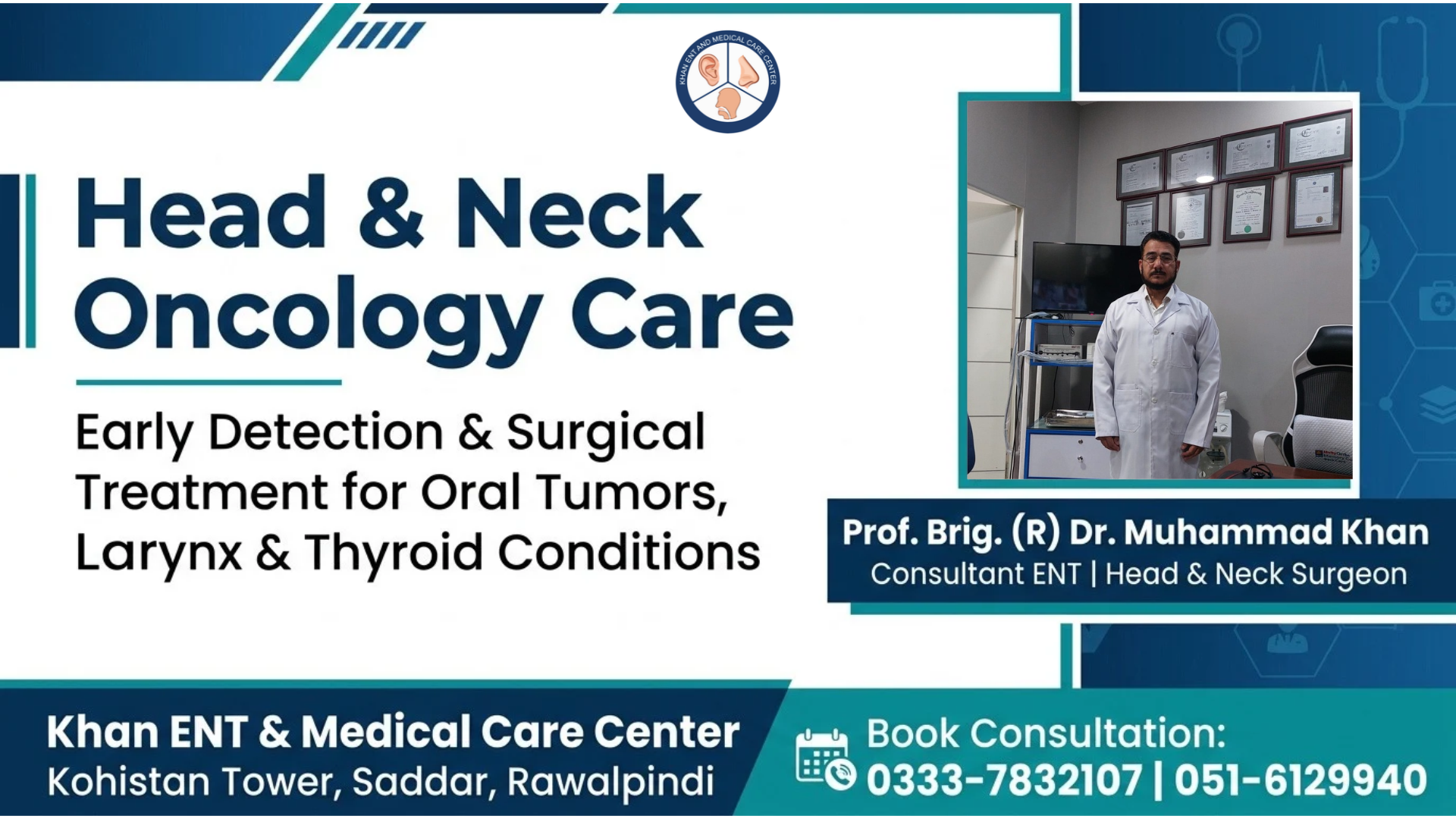
Prof. Brig. (R) Dr. Muhammad Khan provides expert diagnostic evaluation, endoscopic mapping, and surgical care for head and neck conditions at Khan ENT & Medical Care Center in Saddar, Rawalpindi.
Are all mouth ulcers a sign of oral cancer?
No. Most mouth ulcers are benign aphthous sores that heal within 7 to 10 days. However, any ulcer that persists beyond two weeks without healing must be examined by a head and neck cancer specialist.
What are the main risk factors for developing oral tumors?
Major risk factors include tobacco consumption (smoking, paan, gutka, naswar), excessive alcohol use, betel nut chewing, poor oral hygiene, and persistent Human Papillomavirus (HPV) infection.
Is head and neck surgery painful?
Modern surgical procedures utilize precise local and general anesthetic protocols, along with structured post-operative pain management, ensuring patient comfort throughout recovery.
How can I schedule an evaluation with a head and neck cancer specialist?
You can book a consultation directly at Khan ENT & Medical Care Center located at Kohistan Tower, Saddar, Rawalpindi.
Summary and Next Steps
Recognizing early warning signs such as non-healing mouth ulcers, red or white mucosal patches, and unexplained neck lumps is essential for timely intervention. Consulting an experienced head and neck cancer specialist ensures precise endoscopic diagnosis, accurate staging, and expert surgical care tailored to functional preservation and complete recovery.
Consultation & Booking Information
Prof. Brig. (R) Dr. Muhammad Khan
Consultant ENT | Head & Neck Surgeon
30+ Years of Senior Military & Civilian Surgical Expertise
Khan ENT & Medical Care Center
Ground Floor, Kohistan Tower, Mahfooz Road, Opposite AFIC, Saddar, Rawalpindi
Phone / WhatsApp: 0333-7832107 | 0333-8898980 | 051-6129940