
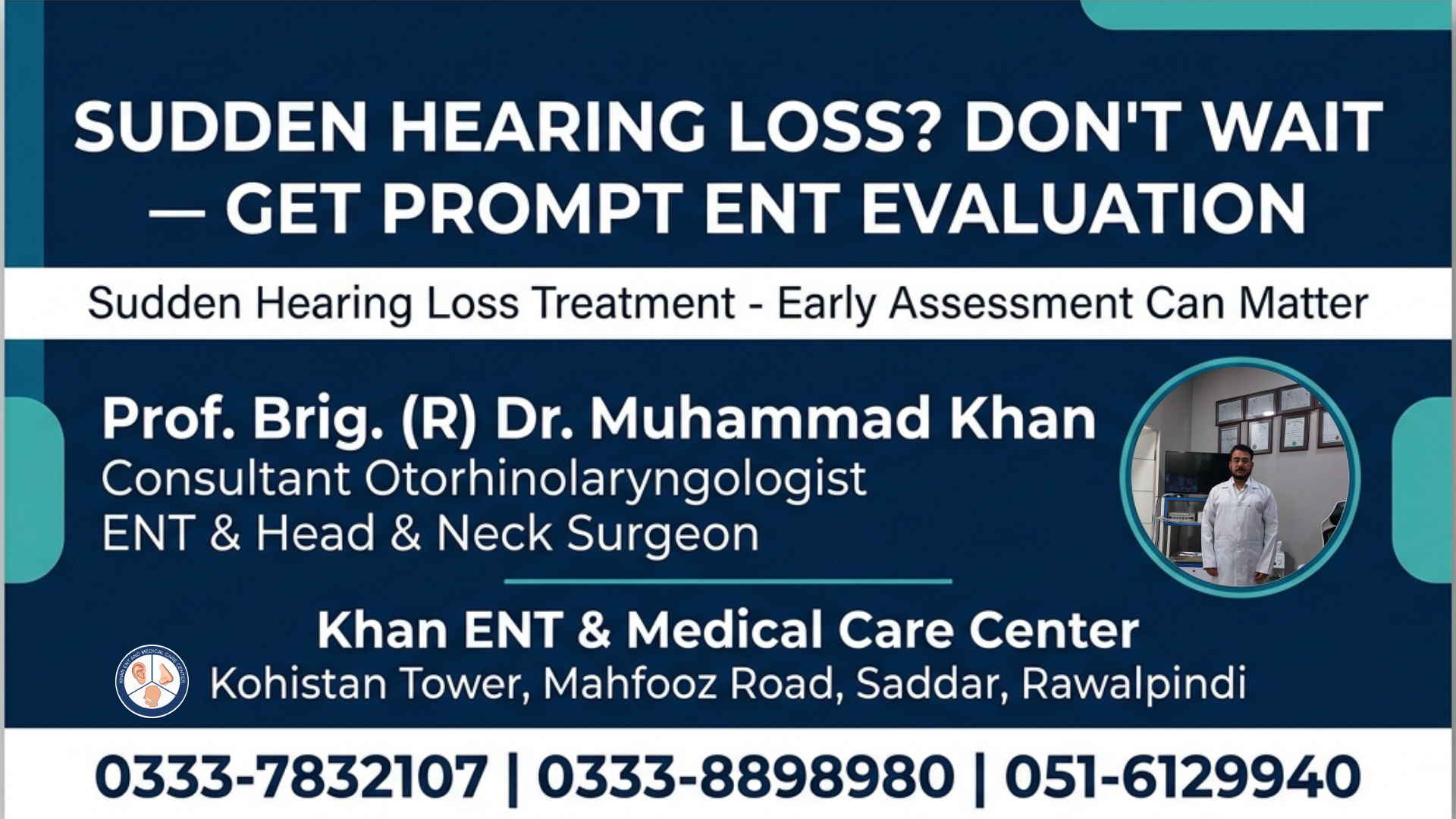
Sudden hearing loss treatment is an important topic because a rapid change in hearing can have several possible causes. A person may suddenly notice muffled sound, reduced hearing in one ear, tinnitus, fullness, or dizziness. Some people assume the ear is blocked by wax or congestion, but a sudden sensorineural hearing problem can feel similar. Prompt medical assessment is therefore important.
This guide explains what patients should do when hearing changes suddenly, which examinations may be recommended, and why timing can matter.
What Is Sudden Hearing Loss?
Sudden hearing loss refers to a rapid decrease in hearing that develops all at once or over a short period, often affecting one ear. Sudden sensorineural hearing loss involves the inner ear or the neural pathways responsible for hearing.
Symptoms may include:
- Reduced hearing in one ear
- Muffled or distorted speech
- Ear fullness or pressure
- New tinnitus or buzzing
- Dizziness or imbalance
The important point is that a suddenly blocked feeling does not automatically mean earwax. Conductive problems and inner-ear hearing loss can produce similar sensations, so the cause needs to be established through examination and hearing testing.
Recognize the Change Quickly
The first step in sudden hearing loss treatment is recognizing that the change is genuinely sudden.
You may notice the problem after waking up, during a telephone call, while using headphones, or when one ear suddenly sounds different from the other. Some people describe the sensation as if cotton has been placed inside the ear.
Pay attention to whether the change is limited to one ear and whether tinnitus, dizziness, or pressure appeared at the same time. These details can help an ENT specialist understand the pattern of symptoms.
Do not assume that a blocked sensation automatically means wax. Earwax, middle-ear fluid, infection, eardrum problems, and inner-ear disorders can all affect hearing.
Arrange Prompt ENT Evaluation
For anyone experiencing a sudden and noticeable hearing reduction, prompt professional evaluation should begin as soon as possible.
An ENT specialist can inspect the ear canal and eardrum, review the history, assess possible conductive causes, and decide whether a hearing test or additional investigation is required.
The National Institute on Deafness and Other Communication Disorders advises people to seek medical attention immediately when sudden deafness symptoms occur. This is because some causes may benefit from treatment when addressed promptly.
Waiting several days to see whether the hearing returns on its own can mean losing valuable time. Even when spontaneous recovery is possible, a clinician should first determine what type of hearing loss may be present.
Rule Out Earwax and Middle-Ear Problems
An important part of the assessment is determining whether the hearing reduction comes from the outer or middle ear rather than the inner ear.
Possible conductive causes include:
- Earwax blocking the canal
- Fluid behind the eardrum
- Middle-ear inflammation or infection
- Eardrum abnormalities
- Foreign material in the ear canal
If significant earwax is found and is responsible for the hearing reduction, appropriate professional removal may improve hearing. If the ear canal and eardrum appear normal but hearing remains suddenly reduced, further assessment may be needed.
This distinction is why patients should not repeatedly clean the ear at home before getting an examination.
Have a Hearing Test Promptly
A hearing test is a key part of sudden hearing loss treatment because it helps determine the type and degree of hearing loss.
Pure-tone audiometry measures hearing sensitivity across different frequencies. Speech audiometry may provide additional information about how clearly speech is heard. Tympanometry can help assess middle-ear function when indicated.
Depending on the clinical picture, an ENT specialist may recommend:
- Ear examination
- Pure-tone audiometry
- Speech audiometry
- Tympanometry
- Balance assessment when dizziness is present
- Further investigations when clinically appropriate
Testing is not simply about confirming that hearing is reduced. It can help distinguish conductive hearing loss from sensorineural hearing loss and establish a useful baseline for follow-up.
Understand That Treatment Depends on the Cause
There is no single approach to sudden hearing loss treatment for every patient.
If the problem is caused by earwax, appropriate removal may be sufficient. If an infection or middle-ear condition is identified, treatment is directed at that cause.
When sudden sensorineural hearing loss is diagnosed, corticosteroids may be considered by the treating clinician. NIDCD identifies corticosteroids as the most common treatment for sudden sensorineural hearing loss when the cause is unknown and notes that they are generally more useful when started promptly.
The American Academy of Otolaryngology–Head and Neck Surgery Foundation guideline states that clinicians may offer corticosteroids as initial therapy within two weeks of symptom onset in appropriate patients.
Steroids are not suitable for everyone and can have important contraindications and side effects. Patients should therefore not begin prescription treatment without medical assessment.
In selected cases, an ENT specialist may also consider steroid medicine delivered through the middle ear, known as intratympanic treatment. The choice depends on timing, severity, medical history, examination findings, and response to treatment.
Do Not Mistake Hearing Loss for Simple Ear Blockage
A common reason patients delay sudden hearing loss treatment is the assumption that a blocked ear simply needs cleaning.
Earwax can reduce hearing, but sudden sensorineural hearing loss may also create fullness or pressure. This can make the two conditions difficult for a patient to distinguish without examination.
Avoid inserting cotton buds, pins, keys, or other objects into the ear canal. These can push wax deeper or cause injury.
Similarly, avoid repeatedly using ear drops unless they have been recommended for your particular situation. If there is an eardrum perforation, previous ear surgery, infection, or another ear condition, some products may not be appropriate.
When hearing changes suddenly, professional assessment is safer than repeated home cleaning.
Take Tinnitus and Dizziness Seriously
Sudden hearing loss treatment becomes particularly important when reduced hearing is accompanied by tinnitus or dizziness.
Seek prompt ENT assessment if you develop:
- Sudden hearing reduction
- New tinnitus
- Ear fullness
- Dizziness or vertigo
- Rapidly worsening hearing
- Ear pain or discharge
- Recent head trauma
The combination of hearing change and dizziness can have several possible causes. Proper examination helps determine whether the symptoms are related to an inner-ear condition, middle-ear problem, or another issue.
Severe neurological symptoms such as facial weakness, difficulty speaking, severe imbalance, or other signs of a possible neurological emergency require urgent emergency medical assessment.
Why Timing Matters
Timing is one of the most important considerations in sudden hearing loss treatment.
NIDCD reports that some people with sudden sensorineural hearing loss may recover some or all hearing spontaneously, often within the first one to two weeks. However, delaying diagnosis and appropriate treatment can decrease the effectiveness of treatment.
This does not mean that every patient will permanently lose hearing or that every person needs steroids. It means that a sudden hearing change deserves timely assessment so potentially important causes are not overlooked.
Early evaluation can also establish a baseline hearing level and allow the clinician to monitor whether hearing is improving, stable, or worsening.
When Should You See an ENT Specialist?
If you experience a sudden and noticeable reduction in hearing, especially in one ear, arrange an ENT assessment promptly.
An ENT specialist can determine whether the problem involves the outer ear, middle ear, inner ear, or another cause. The specialist can also coordinate hearing tests and discuss appropriate management based on the findings.
Do not wait several days simply because the ear feels blocked. Prompt evaluation can help distinguish ordinary conductive problems from conditions involving the inner ear.
Sudden Hearing Loss Treatment in Rawalpindi
For patients looking for sudden hearing loss treatment in Rawalpindi, timely assessment should be the first priority rather than trying multiple home remedies.
At Khan ENT & Medical Care Center in Saddar, Rawalpindi, patients can seek ENT evaluation for sudden changes in hearing and related ear symptoms.
Prof. Brig. (R) Dr. Muhammad Khan is a Consultant Otorhinolaryngologist and ENT & Head & Neck Surgeon. The clinic also provides hearing-related diagnostic services through its dedicated audiology services.
Depending on the examination findings, patients may be advised to undergo hearing testing and further investigation to determine the type and possible cause of the hearing problem.
What Patients Should Do
If your hearing suddenly changes, remember these practical steps:
- Recognize the change and note when it began.
- Arrange prompt ENT assessment.
- Have the ear examined for wax, fluid, infection, or eardrum problems.
- Obtain appropriate hearing testing.
- Follow the recommended treatment plan.
- Avoid cotton buds and objects inside the ear.
- Return for follow-up testing when advised.
Sudden hearing changes should not automatically be dismissed as earwax, sinus congestion, or a temporary blocked-ear sensation.
The goal of sudden hearing loss treatment is to identify the cause quickly and determine whether medical management is appropriate. Different causes require different approaches, so self-treatment is not a substitute for professional evaluation.
For professional ENT evaluation in Saddar, Rawalpindi:
Khan ENT & Medical Care Center
Prof. Brig. (R) Dr. Muhammad Khan
Consultant Otorhinolaryngologist
ENT & Head & Neck Surgeon
Kohistan Tower, Mahfooz Road, Saddar, Rawalpindi
Opposite AFIC / Armed Forces Institute of Cardiology area
0333-7832107 | 0333-8898980 | 051-6129940
Monday–Saturday: 10:00 AM–6:00 PM
Sunday: Closed
If hearing suddenly drops, seek prompt medical advice rather than waiting for the problem to become severe.