
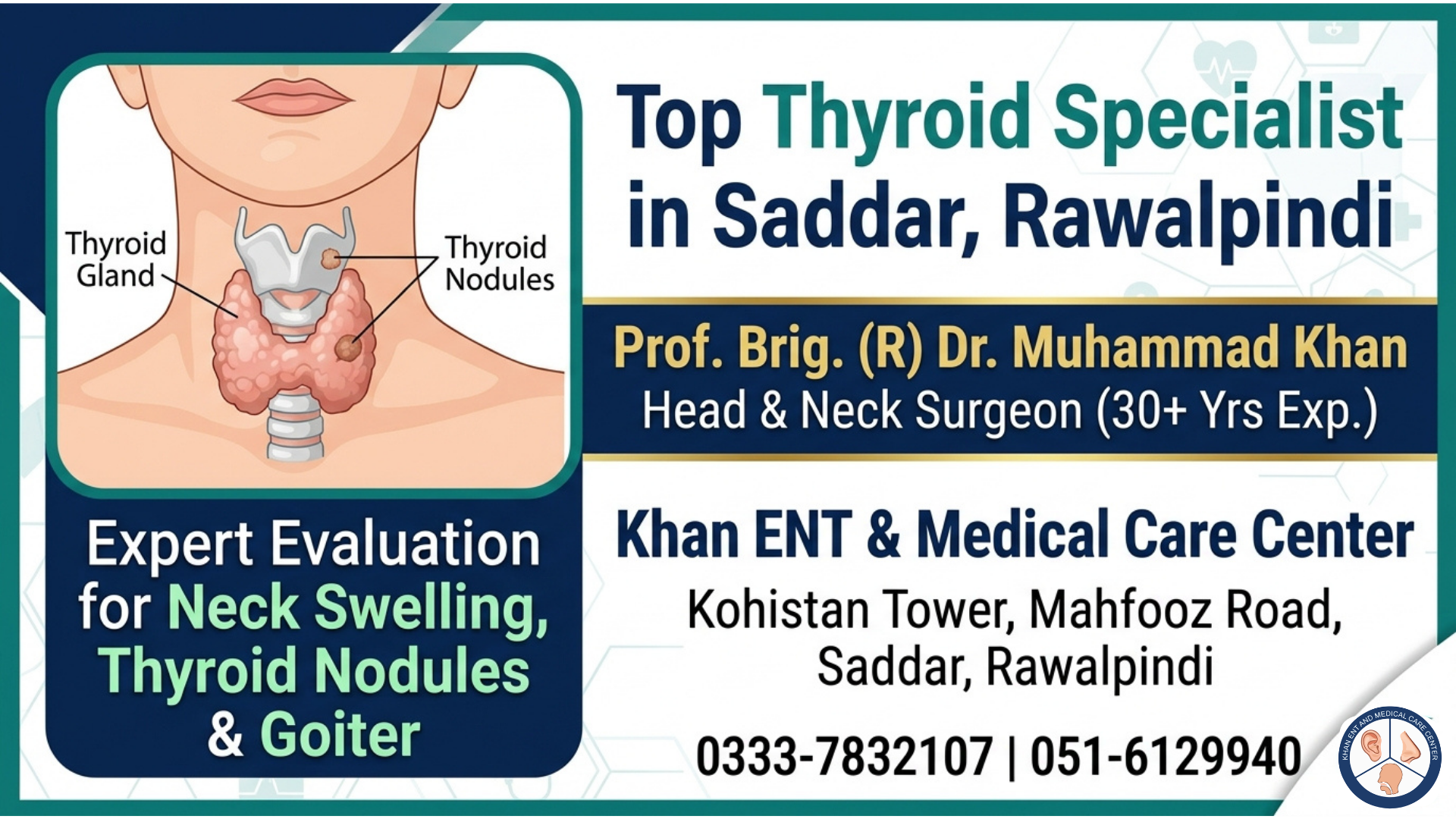
Noticing a visible lump, unexplained tightness, or progressive neck swelling can be a concerning experience. The thyroid gland a butterfly-shaped endocrine organ located at the front base of the neck plays a vital role in regulating your body's metabolism, heart rate, energy levels, and hormonal balance. When a nodule, cyst, or generalized enlargement (goiter) develops, consulting an experienced thyroid specialist rawalpindi becomes essential for an accurate diagnostic evaluation.
In urban medical centers across Rawalpindi and Islamabad, neck swellings can arise from various medical conditions, ranging from benign multinodular goiters and thyroiditis to complex surgical cysts and malignant thyroid tumors. Attempting to self-diagnose or relying solely on basic blood tests without a thorough physical and imaging evaluation can delay appropriate treatment. At Khan ENT & Medical Care Center in Saddar, Rawalpindi, patients receive senior clinical management from Prof. Brig. (R) Dr. Muhammad Khan, a renowned Head & Neck Surgeon and expert thyroid specialist rawalpindi with over 30 years of clinical experience.
Understanding Thyroid Swelling and Neck Nodules
A thyroid swelling occurs when cells within the thyroid gland multiply abnormally, forming a localized nodule or causing diffuse enlargement of the entire gland. While many thyroid nodules are non-cancerous (benign) and asymptomatic, any newly discovered neck mass requires a systematic clinical workup by a dedicated thyroid specialist rawalpindi.
Common underlying causes of thyroid enlargement include:
- Colloid Nodules & Multinodular Goiter: Non-cancerous overgrowths of thyroid tissue, often linked to dietary iodine imbalances or chronic glandular stimulation.
- Thyroid Cysts: Fluid-filled sacs that can develop suddenly, causing localized pressure or discomfort in the lower neck.
- Thyroiditis: Inflammatory conditions of the thyroid gland (such as Hashimoto's thyroiditis or subacute thyroiditis) that cause swelling, tenderness, and fluctuating hormone levels.
- Thyroid Adenomas: Solitary benign tumors that may occasionally produce excess thyroid hormones independently.
- Thyroid Malignancy (Cancer): Malignant growths that present as firm, rapidly growing, or fixed neck nodules requiring immediate evaluation by a surgical thyroid specialist rawalpindi.
Prompt evaluation by a thyroid specialist rawalpindi ensures that serious pathology is ruled out early and an individualized treatment plan is established.
Test 1: Detailed Clinical & Physical Examination
Before performing advanced diagnostic procedures, the diagnostic journey begins with a thorough clinical examination conducted by a skilled thyroid specialist rawalpindi.
During this initial consultation, the clinician evaluates critical physical signs:
- Palpation of the Neck Mass: The specialist carefully examines the neck while you swallow, assessing whether the swelling moves upward with swallowing—a classic diagnostic indicator of thyroid origin.
- Nodule Consistency & Mobility: Assessing whether the lump is soft, cystic, firm, or hard, and evaluating whether it moves freely or is fixed to surrounding neck structures.
- Cervical Lymph Node Inspection: Checking for enlargement of adjacent lymph nodes in the neck, which can indicate acute inflammation or potential malignancy.
- Symptom Mapping: Reviewing mechanical symptoms such as difficulty swallowing (dysphagia), shortness of breath when lying flat, persistent hoarseness, or localized throat pain.
A meticulous physical evaluation allows your thyroid specialist rawalpindi to determine which specialized diagnostic tests are required next.
Test 2: Comprehensive Thyroid Blood Panel (TSH, Free T3, Free T4)
Evaluating the functional state of the thyroid gland is crucial for determining whether the swelling is accompanied by hormonal imbalances. A complete thyroid profile ordered by a thyroid specialist rawalpindi assesses how effectively your endocrine system is operating.
Key biochemical markers include:
- Thyroid-Stimulation Hormone (TSH): Produced by the pituitary gland, TSH acts as the primary indicator of thyroid function. Elevated TSH indicates an underactive thyroid (hypothyroidism), while suppressed TSH points toward an overactive gland (hyperthyroidism).
- Free T3 (Triiodothyronine) & Free T4 (Thyroxine): These active circulating thyroid hormones measure the exact output of your gland. Abnormal levels help your thyroid specialist rawalpindi differentiate between overt thyroid disease and subclinical hormonal dysfunction.
- Thyroid Antibody Tests (TPO Ab & Anti-Tg): High levels of thyroid peroxidase antibodies indicate autoimmune conditions like Hashimoto's or Graves' disease, helping clarify the inflammatory underlying cause of the swelling.
Understanding your hormonal balance enables your thyroid specialist rawalpindi to determine whether medical management or surgical consultation is appropriate.
Test 3: High-Resolution Neck & Thyroid Ultrasound
Ultrasound imaging is the non-invasive gold standard for evaluating structural abnormalities within the neck and thyroid gland. When you visit a thyroid specialist rawalpindi, high-resolution ultrasonography provides immediate, detailed visual mapping of the thyroid architecture without radiation exposure.
| Diagnostic Feature | Clinical Evaluation on Ultrasound | Diagnostic Value for Specialist |
| Nodule Composition | Solid, cystic, or mixed solid-cystic structure | Differentiates benign fluid sacs from solid cellular growths |
| Echogenicity | Hyperechoic, isoechoic, or hypoechoic tissue texture | Hypoechoic solid nodules require closer diagnostic scrutiny |
| Margin Characteristics | Well-defined vs. irregular/microlobulated borders | Smooth margins suggest benign nodules; irregular borders warrant biopsy |
| Calcification Patterns | Coarse calcifications vs. microcalcifications | Tiny punctate microcalcifications are a key risk factor evaluated by the doctor |
| Vascularity (Color Doppler) | Intranodular blood flow vs. peripheral flow | High internal blood flow signals increased cellular activity needing evaluation |
By analyzing these ultrasound features, an experienced thyroid specialist rawalpindi can accurately categorize nodules using standardized risk stratification systems (such as EU-TIRADS) to decide if a needle biopsy is necessary.
Test 4: Fine-Needle Aspiration Cytology (FNAC)
When ultrasound imaging identifies suspicious nodule characteristics, Fine-Needle Aspiration Cytology (FNAC) is the definitive, minimally invasive test used by a surgical thyroid specialist rawalpindi to rule out malignancy.
What to expect during an FNAC procedure:
- Quick & Virtually Painless: Using a very fine needle (smaller than a standard blood draw needle), the clinician extracts cellular samples directly from the thyroid nodule.
- Ultrasound Guidance: The procedure is performed under real-time ultrasound guidance, ensuring precise needle placement inside the exact area of concern while avoiding adjacent blood vessels.
- Pathological Analysis: The extracted cells are placed on glass slides and examined under a microscope by a expert cytopathologist to determine whether the cells are benign, suspicious, or malignant (categorized under the Bethesda System for Reporting Thyroid Cytopathology).
Obtaining an accurate FNAC result gives your thyroid specialist rawalpindi clear histological evidence to recommend either safe observation or definitive surgical intervention.
Test 5: Advanced Cross-Sectional Imaging & Flexible Laryngoscopy
For large goiters, retrosternal swellings (growing down into the chest cavity), or cases involving voice changes, advanced imaging and airway assessment become necessary. A senior thyroid specialist rawalpindi utilizes these specialized tools to plan complex medical or surgical management.
Advanced procedures include:
- Contrast-Enhanced CT Scan or MRI of the Neck: Provides comprehensive cross-sectional views showing the exact dimensions of retrosternal goiters, tracheal compression or displacement, and relationship to major blood vessels in the neck.
- Flexible Fiberoptic Laryngoscopy: An essential diagnostic evaluation where a thin, flexible endoscope is passed through the nose to inspect vocal cord mobility. Ensuring that both vocal cords are moving normally is a vital pre-operative safety check performed by an experienced Head & Neck surgeon.
- Thyroid Isotope Scan (Nuclear Imaging): Utilized primarily in hyperthyroid patients to identify "hot" (hyperfunctioning) or "cold" (non-functioning) nodules.
Through these comprehensive tests, a trusted thyroid specialist rawalpindi constructs a complete diagnostic profile for safe clinical decision-making.
Why Choose Khan ENT & Medical Care Center?
When dealing with thyroid swellings and complex neck masses, having access to experienced clinical leadership and an accessible medical facility is paramount.
Patients seeking a leading thyroid specialist rawalpindi trust Khan ENT & Medical Care Center for several key reasons:
- Senior Surgical Oversight: Direct clinical management by Prof. Brig. (R) Dr. Muhammad Khan, Consultant ENT & Head & Neck Surgeon with 30+ years of clinical excellence in complex neck mass evaluations and thyroid surgeries.
- 100% Step-Free Accessibility: Located on the Ground Floor at Kohistan Tower, Saddar—providing convenient, barrier-free access for elderly patients, individuals with mobility challenges, and wheelchair users.
- Comprehensive Diagnostic Integration: Full diagnostic evaluation for thyroid nodules, voice changes, swallowing difficulties, and general head and neck pathologies under one roof.
Selecting a qualified thyroid specialist rawalpindi ensures that your neck health is thoroughly evaluated with precision, empathy, and professional integrity.
Frequently Asked Questions
Do all thyroid swellings require surgery?
No. The majority of thyroid nodules and mild multinodular goiters are benign and can be safely monitored with periodic ultrasound scans and blood tests. Surgery is recommended by your thyroid specialist rawalpindi if FNAC results indicate malignancy, or if a large goiter causes mechanical symptoms like breathing difficulty, swallowing problems, or severe cosmetic deformity.
What symptoms indicate that I should see a thyroid specialist immediately?
You should schedule an immediate evaluation with a thyroid specialist rawalpindi if you notice a rapidly enlarging neck mass, sudden voice hoarseness, difficulty swallowing food or liquids, unexplained shortness of breath, or firm lumps in the side of your neck.
Is thyroid surgery safe?
When performed by an experienced Head & Neck Surgeon and dedicated thyroid specialist rawalpindi, thyroidectomy is a safe procedure. Meticulous surgical technique ensures the protection of the recurrent laryngeal nerves (which control your voice) and the parathyroid glands (which regulate calcium levels).
What are the clinic operating hours?
Our clinic is open for consultations, diagnostic evaluations, and post-operative follow-ups from Monday through Saturday. Please note that the clinic is closed every Sunday.
Book Your Thyroid & Neck Evaluation Today
If you or a loved one has noticed a neck swelling, nodule, or throat pressure, do not delay seeking professional advice. Schedule a comprehensive consultation with a leading thyroid specialist rawalpindi at our accessible ground-floor practice in Saddar today.
Prof. Brig. (R) Dr. Muhammad Khan
Consultant ENT | Head & Neck Surgeon (30+ Years Senior Clinical Expertise)
Khan ENT & Medical Care Center
Ground Floor, Kohistan Tower, Mahfooz Road, Opposite AFIC, Saddar, Rawalpindi
Book Your Consultation: 0333-7832107 | 0333-8898980 | 051-6129940