
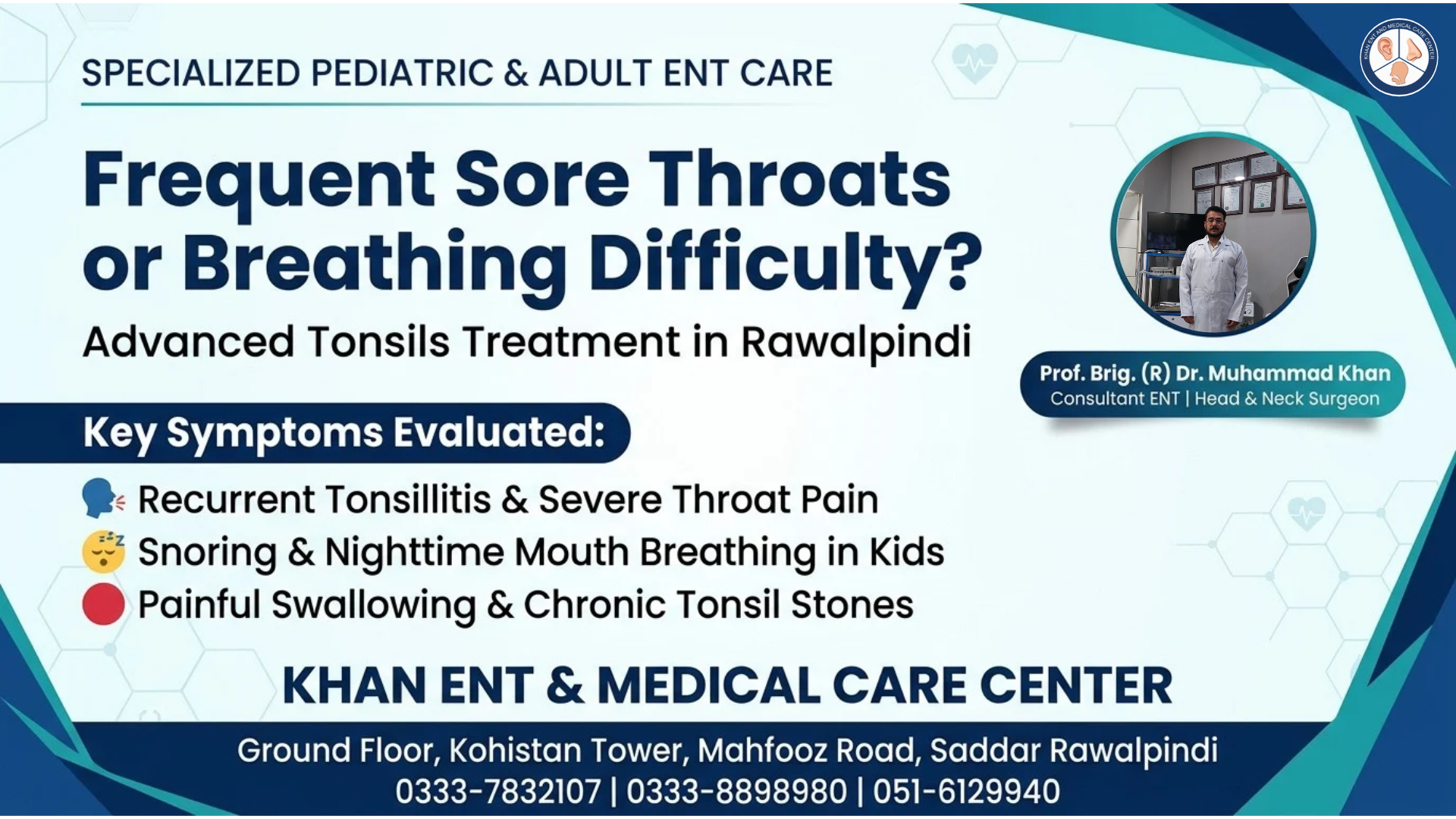
Severe sore throats, painful swallowing, high fever, and sleep-disordered breathing are common warning signs of acute or chronic tonsil inflammation. Palatine tonsils the oval lymphoid tissue masses located at the back of the pharynx serve as the body’s first line of immune defense against inhaled or ingested pathogens. However, when these tissues suffer repeated bacterial or viral infections, obtaining specialized tonsils treatment in Rawalpindi becomes necessary to restore throat comfort and safeguard overall respiratory health.
While mild viral throat infections resolve with supportive home care, persistent tonsillitis and massive tonsillar hypertrophy require clinical intervention. Unchecked tonsillar disease can lead to sleep apnea, middle ear infections, peritonsillar abscesses, and chronic halitosis. Seeking medical tonsils treatment in Rawalpindi ensures an accurate clinical diagnosis and prevents long-term health complications for both pediatric and adult patients.
Understanding Tonsillitis and Tonsillar Hypertrophy
Tonsillitis occurs when viruses or bacteria infect the lymphoid tissue of the pharynx, causing swelling, redness, and purulent exudate. In pediatric patients, inflamed tonsils frequently enlarge alongside the adenoids, causing upper airway obstruction during sleep.
| Clinical Condition | Primary Symptoms | Recommended Clinical Focus |
| Acute Tonsillitis | Sudden severe throat pain, high fever, swollen glands | Targeted antibiotic or antiviral therapy |
| Recurrent Tonsillitis | 5 to 7 documented throat infections within 12 months | Evaluation for long-term tonsils treatment in Rawalpindi |
| Chronic Tonsillitis | Persistent low-grade throat soreness, tonsil stones, bad breath | Targeted mucosal hygiene or surgical care |
| Tonsillar Hypertrophy | Loud snoring, restless sleep, mouth breathing, sleep apnea | Airway evaluation & surgical tonsillectomy |
Choosing an experienced otolaryngologist for tonsils treatment in Rawalpindi allows patients to receive tailored therapy suited to their specific stage of disease.
Clinical Indications for Medical vs. Surgical Care
Determining whether a patient requires non-surgical conservative therapy or surgical removal depends on strict clinical criteria. During consultations for tonsils treatment in Rawalpindi, ENT specialists utilize international Paradise Criteria guidelines to evaluate candidacy for tonsillectomy:
- Infection Frequency: 7 or more episodes of acute throat infection in the preceding year, or 5 episodes per year for two consecutive years.
- Obstructive Sleep Symptoms: Severe nighttime airway blockage, loud snoring, gasping for breath, or daytime fatigue due to enlarged tonsils.
- Complications: Peritonsillar abscess formation (quinsy), febrile seizures, or suspected tissue asymmetry.
Receiving a structured consultation for tonsils treatment in Rawalpindi ensures that surgery is only recommended when clear, objective medical benefits are established.
Repeated bacterial infections can turn the tonsils from protective immune barriers into chronic reservoirs of harmful bacteria, requiring clinical evaluation.
Best 7 Tonsils Treatment in Rawalpindi Options
Depending on patient age, infection frequency, and structural airway obstruction, therapeutic interventions range from targeted medical regimens to advanced daycare surgery:
Option 1: Targeted Antibacterial & Antimicrobial Therapy
For acute bacterial tonsillitis (most commonly caused by Streptococcus pyogenes), a complete 10-day course of targeted oral antibiotics clears infection, reduces pain, and prevents systemic complications such as rheumatic fever. Timely antibiotic tonsils treatment in Rawalpindi stops early bacterial spread effectively.
Option 2: Anti-Inflammatory & Analgesic Management
Prescription anti-inflammatory medications and warm hypertonic saline gargles reduce pharyngeal edema, soothe localized inflammation, and ease swallowing difficulties during acute viral or bacterial episodes.
Option 3: Professional Removal of Tonsil Stones (Tonsilloliths)
Chronic tonsillitis leads to deep mucosal crypts where debris, dead cells, and bacteria collect, forming foul-smelling tonsil stones. Specialized clinical crypt irrigation and gentle suction offer non-surgical tonsils treatment in Rawalpindi for chronic halitosis and throat irritation.
Option 4: Pediatric Coblation / Radiofrequency Tonsillectomy
For children suffering from airway obstruction or recurrent infections, Coblation (cold ablation) technology uses radiofrequency energy and saline to gently dissolve tonsillar tissue at lower temperatures ($40^\circ\text{C}$ to $70^\circ\text{C}$). This modern surgical tonsils treatment in Rawalpindi minimizes thermal damage, reduces post-operative pain, and accelerates healing.
| Treatment Technique | Operating Temperature | Post-Op Pain Level | Recovery Time |
| Traditional Electrocautery | $200^\circ\text{C} - 400^\circ\text{C}$ | Moderate to High | 10–14 Days |
| Coblation / Radiofrequency | $40^\circ\text{C} - 70^\circ\text{C}$ | Low to Mild | 5–7 Days |
| Microdebrider Intracapsular | Mechanical Cutting | Low | 4–6 Days |
Option 5: Partial Intracapsular Tonsillectomy
In pediatric obstructive sleep apnea where infections are absent, partial removal removes the blocking lymphoid tissue while preserving the outer capsule. This partial surgical tonsils treatment in Rawalpindi protects surrounding pharyngeal muscles, lowering post-surgical bleeding risks.
Option 6: Adult Dissection & Suture Tonsillectomy
Adult tonsillectomy requires meticulous dissection techniques due to denser fibrotic tissue. Surgical excision under general anesthesia removes chronic infection sources permanently, providing adult patients with definitive tonsils treatment in Rawalpindi.
Option 7: Management of Peritonsillar Abscess (Quinsy)
When severe infection spreads beyond the tonsillar capsule, an abscess forms, causing severe throat pain, difficulty opening the mouth (trismus), and voice changes. Immediate needle aspiration or incision and drainage under local anesthesia provides urgent relief as part of advanced tonsils treatment in Rawalpindi.
Health Benefits of Timely Tonsil Intervention
Choosing appropriate tonsils treatment in Rawalpindi offers long-lasting health improvements for patients of all ages:
- Restored Sleep Quality & Airway Patency: Eliminates heavy snoring, sleep apnea episodes, and restless sleep patterns in growing children.
- Dramatic Reduction in Throat Infections: Stops frequent school or work absences caused by recurring sore throats and high fevers.
- Improved Swallowing & Growth: Allows children to swallow comfortably, improving appetite and weight gain.
- Eradication of Bad Breath: Resolves chronic foul odor caused by deep tonsillar crypts and tonsil stones.
Undergoing expert evaluation for tonsils treatment in Rawalpindi restores pharyngeal comfort and daily quality of life.
Frequently Asked Questions (FAQs)
What are the main signs that my child needs tonsils treatment in Rawalpindi?
Frequent sore throats, difficulty swallowing, mouth breathing, loud snoring during sleep, and unexplained high fevers are key indications that your child requires an ENT consultation.
Is tonsil removal surgery (tonsillectomy) always necessary for tonsillitis?
No. Mild or infrequent episodes are managed with oral antibiotics, anti-inflammatories, and supportive care. Surgery is only recommended for recurrent infections or airway blockage.
What is Coblation tonsillectomy and how is it different?
Coblation uses low-temperature radiofrequency energy and saline to remove tonsillar tissue with minimal heat damage, resulting in significantly less post-operative pain and faster recovery.
How long does recovery take after tonsil surgery?
Pediatric patients usually recover within 5 to 7 days, while adult recovery takes about 10 to 14 days due to denser fibrous tissue.
Will removing the tonsils weaken my child's immune system?
No. Research shows that removing chronically infected tonsils does not compromise immunity because other lymphoid tissues in the throat take over their protective role.
Can tonsil stones be treated without surgery?
Yes. Mild tonsil stones can be managed with saline gargles and clinical crypt cleansing. However, severe cases with persistent bad breath may require definitive surgical care.
What food should a patient eat after undergoing tonsils treatment in Rawalpindi via surgery?
Patients should stick to soft, cool foods such as ice cream, yogurt, custard, cold milk, and bland liquids for the first 7 to 10 days, avoiding hot, spicy, or crunchy foods.
What is a peritonsillar abscess (quinsy)?
A peritonsillar abscess is a painful collection of pus behind the tonsil caused by untreated bacterial infection, requiring prompt clinical drainage.
Can adults get their tonsils removed?
Yes. While more common in children, adults with chronic tonsillitis, severe tonsil stones, or obstructive sleep apnea frequently undergo tonsillectomy with excellent outcomes.
Where can I consult for specialized tonsils treatment in Rawalpindi?
Prof. Brig. (R) Dr. Muhammad Khan offers comprehensive pediatric and adult clinical consultations and advanced surgical care at Khan ENT & Medical Care Center in Saddar, Rawalpindi.
Recurring sore throats, difficulty swallowing, and sleep-disordered breathing should never be left unaddressed. By seeking professional tonsils treatment in Rawalpindi, you can determine whether medical management or modern surgical removal is the right path to long-term health.
If you or your child suffer from frequent throat infections or enlarged tonsils, scheduling a consultation for tonsils treatment in Rawalpindi is the most effective step toward clear breathing and healthy throat function.
Consultation & Contact Details
Prof. Brig. (R) Dr. Muhammad Khan
Consultant ENT | Head & Neck Surgeon
30+ Years of Senior Military & Civilian Surgical Expertise
Khan ENT & Medical Care Center
Ground Floor, Kohistan Tower, Mahfooz Road, Opposite AFIC, Saddar, Rawalpindi
Phone / WhatsApp: 0333-7832107 | 0333-8898980 | 051-6129940