
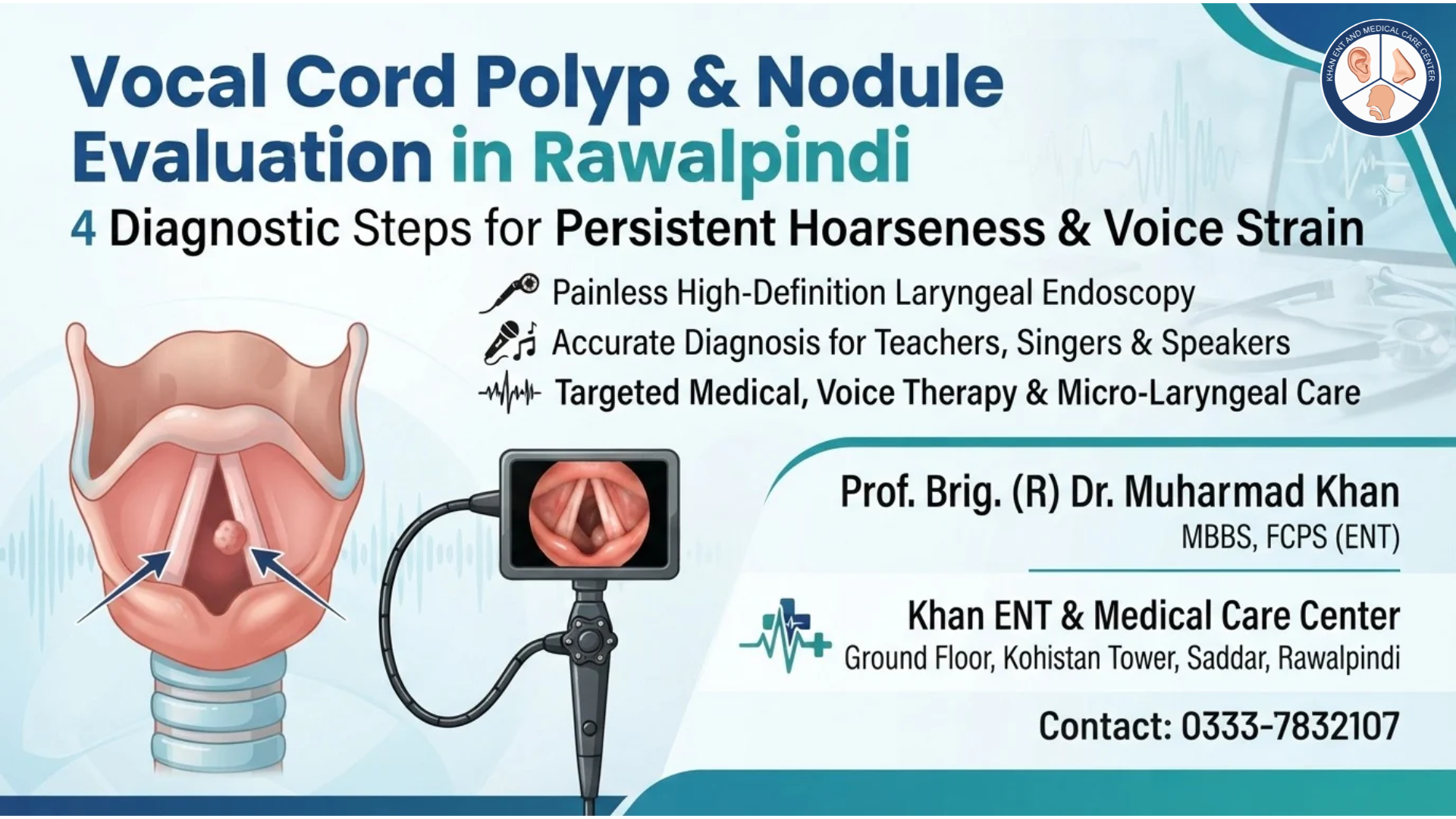
A raspy voice after a viral flu or a loud family gathering usually clears within a few days of rest and warm fluids. However, when hoarseness, breathy speech, vocal fatigue, or sudden voice breaks linger beyond two weeks, your vocal folds may have developed benign structural lesions such as vocal cord nodules or a vocal cord polyp. Consulting a qualified vocal cord specialist rawalpindi early ensures these delicate vibratory structures are examined directly before ongoing vocal strain causes permanent voice changes or hides more serious laryngeal conditions.
At Khan ENT & Medical Care Center on the ground floor of Kohistan Tower in Saddar, Rawalpindi, Prof. Brig. (R) Dr. Muhammad Khan brings more than 30 years of senior consultant expertise in ENT and Head & Neck Surgery to patients experiencing persistent voice disorders. Using high-definition endoscopic visualization and gentle clinical assessment, a vocal cord specialist rawalpindi can distinguish between vocal cord nodules, polyps, cysts, and acid reflux irritation during a single visit. Below, we walk through the four structured diagnostic steps used to evaluate vocal cord polyps and nodules accurately and comfortably.
Understanding Vocal Cord Polyps vs. Vocal Cord Nodules
Your vocal cords (vocal folds) are two delicate bands of smooth muscle and vibrating mucosal tissue inside the voice box (larynx). When air passes from the lungs through the closed vocal cords, they vibrate hundreds of times per second to produce clear sound. Any swelling, bump, or irregular edge disrupts smooth vibration, causing hoarseness or pitch breaks.
Before beginning treatment, a vocal cord specialist rawalpindi determines which type of lesion is affecting your voice:
- Vocal Cord Nodules: Often called "singer’s nodes" or "teacher’s nodules," these are bilateral (paired) callous-like thickenings that form symmetrically on both vocal cords where they strike each other hardest during repetitive voice overuse. They are especially common among school and university teachers, lecturers, Naat reciters, singers, mosque imams, and call center professionals.
- Vocal Cord Polyps: Typically unilateral (occurring on one vocal cord), a polyp is a softer, fluid-filled or blood-vessel-rich blister-like swelling. Unlike nodules that develop gradually from chronic strain, a vocal cord polyp can appear after a single episode of acute vocal trauma such as shouting loudly or from ongoing irritation caused by smoking and stomach acid reflux.
- Why Direct Visualization Matters: Because early nodules, polyps, vocal cord cysts, and precancerous leukoplakia can sound identical to the human ear, listening to a patient's voice alone is never enough. Only a direct optical examination by an experienced vocal cord specialist rawalpindi provides a definitive diagnosis.
Step 1: Detailed Vocal History & Lifestyle Trigger Assessment
Every thorough laryngeal workup at Khan ENT & Medical Care Center begins with listening carefully to how your voice problem started, how it behaves throughout the day, and what daily habits stress your throat.
During this initial step, your vocal cord specialist rawalpindi reviews several critical clinical clues:
- Duration and Onset of Hoarseness: Did your voice change gradually over months of classroom teaching, or did hoarseness start suddenly after shouting, coughing violently, or recovering from an upper respiratory infection?
- Daily Voice Demands: Understanding whether you speak for hours without amplification, project over background noise, or sing helps identify mechanical phonotrauma.
- Silent Acid Reflux (Laryngopharyngeal Reflux – LPR): Stomach acid and digestive enzymes traveling upward into the throat frequently inflame the back of the vocal cords even without classic heartburn. Morning hoarseness, constant throat clearing, excess throat mucus, and a "lump-in-the-throat" sensation (globus) point strongly toward LPR.
- Hydration, Smoking & Environmental Irritants: Dehydration dries the protective mucus layer covering the vocal folds, while cigarette smoke, shisha, dust, and dry winter air increase tissue swelling and polyp formation.
- Red-Flag Screening: Your vocal cord specialist rawalpindi also screens for warning signs such as pain radiating to the ear, difficulty swallowing, unexplained weight loss, or a history of tobacco use, ensuring serious pathology is ruled out promptly.
Step 2: Complete Ear, Nose & Upper Throat Examination
Your voice box does not work in isolation the nose, sinuses, and upper pharynx act as the natural resonating chamber and air-conditioning system for your vocal cords.
Before inspecting the larynx itself, a vocal cord specialist rawalpindi performs a complete head, neck, and upper airway examination:
- Nasal & Sinus Evaluation: Chronic nasal blockage from allergies, a deviated nasal septum, or sinusitis forces patients to breathe through their mouth, drying out the vocal cords and causing thick post-nasal drip to coat the voice box.
- Oropharynx & Neck Palpation: Checking the tonsils, back of the throat, and neck lymph nodes alongside gentle palpation of the external laryngeal muscles reveals excessive neck muscle tension (muscle tension dysphonia) that frequently accompanies vocal cord nodules and polyps.
Step 3: Painless High-Definition Laryngeal Endoscopy
The centerpiece of modern voice evaluation is high-definition endoscopic laryngoscopy. Rather than relying on a tiny angled hand mirror that offers only a brief, low-magnification glimpse, a vocal cord specialist rawalpindi uses precision optical endoscopes to inspect the vocal folds clearly and comfortably:
- How the Procedure Works: Depending on your gag reflex and nasal anatomy, Dr. Muhammad Khan performs either a rigid transoral laryngoscopy or a slender, flexible nasopharyngolaryngoscopy passed gently through the nostril after applying a mild numbing spray. The entire examination typically takes less than two minutes and requires no sedation or fasting.
- What the Endoscope Reveals: Under bright, magnified illumination, your vocal cord specialist rawalpindi evaluates the exact size, shape, color, and symmetry of both vocal cords identifying symmetric pinpoint nodules on the anterior-middle third of the folds, a single hemorrhagic or gelatinous polyp, swelling from acid reflux, or incomplete glottic closure (an air gap between the vocal cords during speech).
- Dynamic Movement Check: Asking you to say sustained vowel sounds ("eee") at different pitches allows real-time observation of vocal cord mobility, stiffness, and closure patterns.
Step 4: Customized Treatment Planning (Voice Therapy, Medical Care & Micro-Surgery)
Once endoscopic evaluation confirms whether you have vocal cord nodules, a vocal cord polyp, or reflux-related inflammation, your vocal cord specialist rawalpindi designs a tailored, conservative-first recovery plan:
- Structured Voice Therapy & Vocal Hygiene: Most early vocal cord nodules shrink and resolve completely without surgery when patients follow guided voice therapy, hydration protocols, breath-support exercises, and vocal rest strategies.
- Targeted Medical Therapy: When allergies, sinus post-nasal drip, or silent reflux (LPR) contribute to vocal fold swelling, treating those underlying triggers with targeted nasal sprays, dietary adjustments, and acid-control medication dramatically accelerates healing.
- Precision Micro-Laryngeal Surgery (When Needed): Larger, firm vocal cord polyps or long-standing fibrotic lesions that do not respond to conservative therapy may benefit from delicate endoscopic micro-laryngeal removal. Discussing surgical vs. non-surgical options transparently with a vocal cord specialist rawalpindi ensures you never undergo unnecessary procedures while achieving clear, reliable voice restoration.
Why Patients Choose Khan ENT & Medical Care Center in Saddar
Selecting the right vocal cord specialist rawalpindi combines senior clinical judgment with modern diagnostic precision and convenient clinic access:
- 30+ Years of Consultant Experience: Prof. Brig. (R) Dr. Muhammad Khan is a highly experienced Consultant ENT and Head & Neck Surgeon who has led ENT departments at major tertiary hospitals including CMH Rawalpindi, CMH Lahore, and CMH Bahawalpur.
- In-Clinic Endoscopic Diagnostics: High-definition nasal and laryngeal endoscopy is performed directly during your consultation at our Saddar clinic, giving you clear diagnostic answers without hospital delays.
- 100% Step-Free Street Entrance: Located at Ground Floor, Kohistan Tower, Mahfooz Road, Opposite AFIC, Saddar, Rawalpindi, our clinic offers effortless ground-floor access for elderly patients, wheelchair users, and families with strollers.
Frequently Asked Questions About Vocal Cord Evaluation
When should I visit a vocal cord specialist rawalpindi for a hoarse voice?
You should consult a vocal cord specialist rawalpindi whenever hoarseness, voice raspiness, or vocal fatigue lasts longer than two weeks, or sooner if you rely on your voice professionally (teaching, public speaking, singing) or experience swallowing pain.
Is laryngeal endoscopy painful?
No. A mild topical numbing spray keeps your throat and nasal passage comfortable while your vocal cord specialist rawalpindi completes the high-definition endoscopic view in under two minutes.
Do all vocal cord polyps and nodules require surgery?
No. Most vocal cord nodules improve significantly with voice rest, hydration, reflux control, and structured voice therapy. Only persistent, larger polyps or lesions unresponsive to conservative care require micro-laryngeal surgery.
How can I book a voice checkup in Saddar, Rawalpindi?
You can schedule an appointment with Prof. Brig. (R) Dr. Muhammad Khan, an experienced vocal cord specialist rawalpindi, by calling or messaging 0333-7832107 Monday through Saturday between 10:00 AM and 6:00 PM.
Restore Your Clear, Confident Voice Today
Don’t ignore persistent hoarseness or strain your voice further without knowing the true cause. Schedule your endoscopic evaluation with Prof. Brig. (R) Dr. Muhammad Khan, your trusted vocal cord specialist rawalpindi, at Khan ENT & Medical Care Center today.
Prof. Brig. (R) Dr. Muhammad Khan
Consultant ENT | Head & Neck Surgeon (30+ Years Senior Clinical Experience)
Khan ENT & Medical Care Center
Ground Floor, Kohistan Tower, Mahfooz Road, Opposite AFIC, Saddar, Rawalpindi
Appointment Helpline Number: 0333-7832107