
Noticing a sudden, tender swelling beneath your jawline right before a meal or discovering a painless, slow-growing lump just in front of or below your ear can be deeply unsettling. Because your salivary glands sit closely alongside critical facial nerves, major blood vessels, and neck lymph nodes, any persistent fullness or lump in the cheek or upper neck deserves prompt evaluation by an experienced salivary gland doctor rawalpindi.
At Khan ENT & Medical Care Center on the ground floor of Kohistan Tower in Saddar, Rawalpindi, Prof. Brig. (R) Dr. Muhammad Khan brings over 30 years of senior consultant expertise in ENT and Head & Neck Surgery to patients experiencing salivary gland disorders. Rather than relying on repeated courses of blind antibiotics, a dedicated salivary gland doctor rawalpindi follows a structured diagnostic and treatment pathway to pinpoint whether swelling is caused by a blocked salivary stone, an acute infection, autoimmune inflammation, or a salivary gland tumor. Below, we explain the three specialist protocols used to evaluate and treat salivary gland swelling safely and accurately.
Understanding the Major Salivary Glands & Common Causes of Swelling
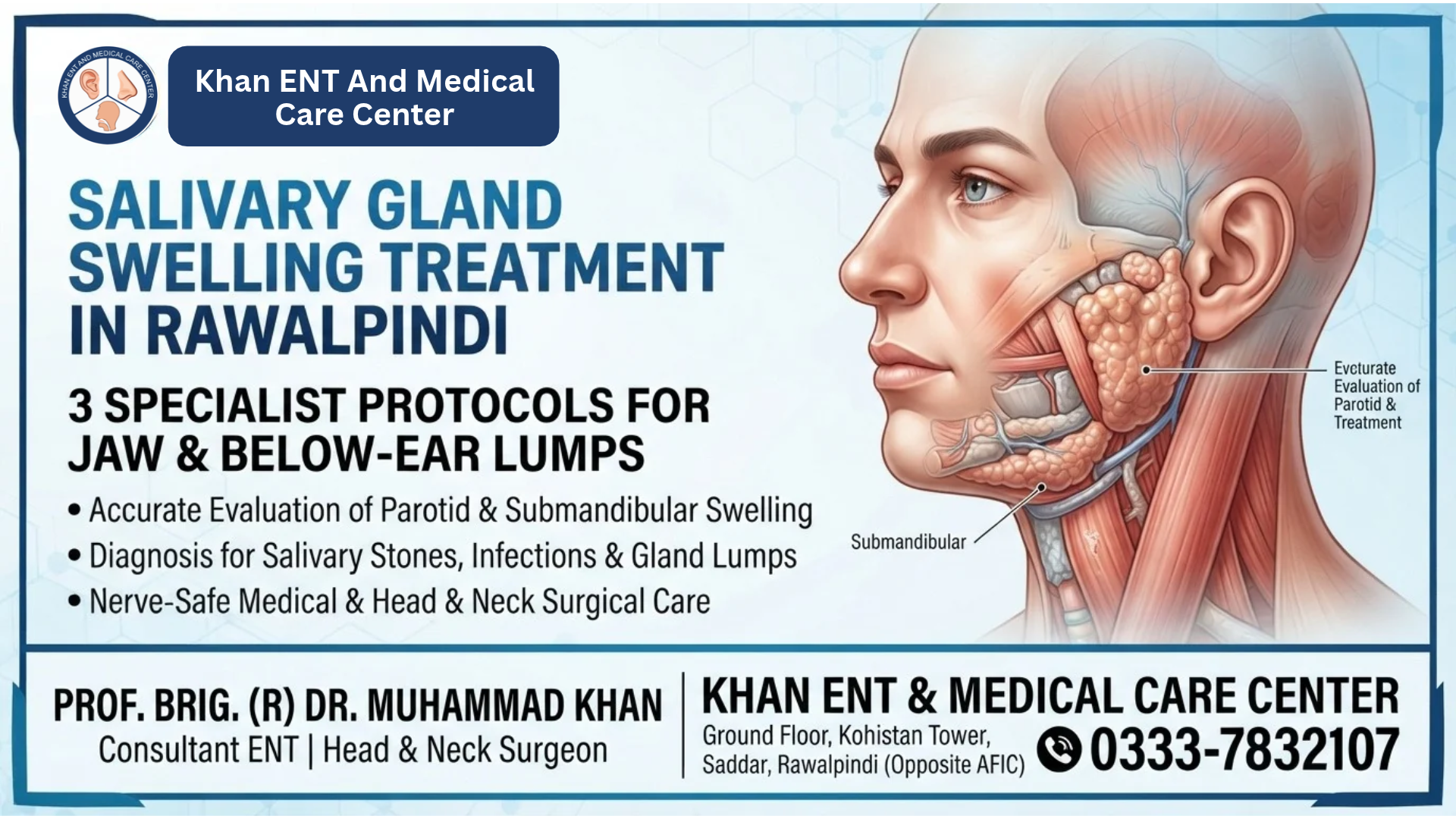
Humans have three pairs of major salivary glands along with hundreds of microscopic minor salivary glands lining the mouth and throat that produce saliva to moisten food, protect teeth, and support digestion:
- Parotid Glands: The largest salivary glands, located in front of and just below each ear, draining saliva into the mouth through Stensen’s duct opposite the upper molar teeth.
- Submandibular Glands: Located beneath the lower jawbone on both sides, draining under the tongue through Wharton’s duct the most common site for salivary stones.
- Sublingual Glands: Positioned directly under the floor of the mouth beneath the tongue.
When saliva flow slows down, thickens, or becomes physically blocked, pressure builds inside the gland. Consulting a qualified salivary gland doctor rawalpindi helps distinguish between four primary culprits:
- Salivary Stones (Sialolithiasis): Calcified mineral deposits that block a salivary duct, causing classic "mealtime syndrome" painful swelling under the jaw or cheek that flares up when you eat or smell food and gradually subsides afterward.
- Bacterial or Viral Infection (Sialadenitis): Dehydration, duct blockage, or viral illnesses (such as mumps) can trigger acute inflammation, redness, warmth, fever, and sometimes pus draining inside the mouth.
- Chronic Inflammation or Autoimmune Conditions: Recurrent dry mouth and bilateral gland enlargement linked to conditions like Sjögren’s syndrome or post-radiation dryness.
- Salivary Gland Neoplasms (Tumors): While roughly 80% of parotid lumps are benign (such as pleomorphic adenoma or Warthin’s tumor), every discrete salivary mass requires careful evaluation by a salivary gland doctor rawalpindi to rule out malignancy early.
Protocol 1: Targeted Head & Neck Clinical Mapping & Intraoral Duct Inspection
Every accurate diagnosis at Khan ENT & Medical Care Center begins with a meticulous, hands-on clinical examination rather than guesswork.
During this first specialist protocol, your salivary gland doctor rawalpindi evaluates both the external neck contours and the internal drainage openings inside your mouth:
- Symptom Pattern & Mealtime Trigger Review: Clarifying whether swelling fluctuates with meals, worsens during dehydration or fasting, or has grown steadily without pain over several months.
- Bimanual Palpation of the Gland & Duct: Using one gloved finger gently along the floor of the mouth and the other hand beneath the jaw, a salivary gland doctor rawalpindi can often feel a hard salivary stone lodged inside Wharton’s duct or assess the exact size, mobility, and firmness of a parotid or submandibular lump.
- Salivary Orifice & Fluid Inspection: Inspecting the tiny duct openings inside the cheek and under the tongue while gently massaging the gland reveals whether clear saliva flows freely, whether saliva is sluggish and thick, or whether cloudy pus indicates bacterial sialadenitis.
- Facial Nerve Integrity Check: Because the facial nerve (cranial nerve VII) runs directly through the parotid gland to control smiling, eye closure, and forehead movement, your salivary gland doctor rawalpindi carefully checks every branch of facial movement during your very first visit.
Protocol 2: High-Resolution Imaging & Ultrasound-Guided Tissue Diagnosis
When clinical examination identifies a deeper stone, recurrent duct obstruction, or a solid salivary mass, modern diagnostic imaging prevents unnecessary surgery and ensures total clarity before treatment begins.
In this second protocol, your salivary gland doctor rawalpindi selects targeted, non-invasive diagnostics:
- High-Resolution Neck & Salivary Ultrasound: The ideal first-line imaging tool for evaluating parotid and submandibular swelling quickly distinguishing fluid-filled cysts, dilated salivary ducts, calcified stones, and solid nodules without radiation exposure.
- CT Scan (Non-Contrast or Contrast): Especially valuable when tiny, deep salivary stones are suspected inside the submandibular or parotid duct system, or when mapping complex anatomical relationships.
- Fine Needle Aspiration Cytology (FNAC): If a distinct, firm lump is present inside the parotid or submandibular gland, a salivary gland doctor rawalpindi arranges a gentle, thin-needle tissue sample (FNAC) to determine whether the cells are benign or malignant prior to planning surgery ensuring no surprises in the operating room.
Protocol 3: Conservative Stone/Infection Relief vs. Nerve-Safe Head & Neck Surgery
Once the underlying cause is confirmed, your salivary gland doctor rawalpindi customizes treatment around preserving healthy gland function and protecting surrounding nerves:
- Conservative Medical & Stone-Flushing Care: Many small salivary stones and early gland infections resolve completely without surgery through aggressive hydration, warm compresses, gentle gland massage, sialogogues (sour lemon drops to stimulate natural saliva flow), targeted antibiotics when bacterial infection is present, and simple office stone release if a calculus sits right at the duct opening.
- Micro-Surgical & Nerve-Preserving Excision: When a large stone remains trapped deep inside the submandibular gland or when a confirmed salivary tumor requires removal definitive surgical care is essential. Performing procedures such as submandibular gland excision or superficial parotidectomy requires an experienced Head & Neck Surgeon who meticulously identifies and preserves the facial nerve, lingual nerve, and hypoglossal nerve. Discussing surgical options directly with a senior salivary gland doctor rawalpindi ensures both complete lesion removal and optimal cosmetic and nerve-safe outcomes.
Red-Flag Symptoms: When to See a Salivary Gland Specialist Immediately
While mild dehydration-related gland tenderness often settles quickly, you should book an urgent appointment with a salivary gland doctor rawalpindi if you notice any of the following warning signs:
- A firm, painless lump in front of the ear, near the angle of the jaw, or under the chin that persists for more than two weeks.
- Rapidly enlarging cheek or neck swelling accompanied by high fever, skin redness, or severe throbbing pain.
- Facial weakness or asymmetry such as difficulty closing one eye, drooping at the corner of the mouth, or numbness on one side of the face.
- Difficulty swallowing, trouble opening your mouth fully (trismus), or persistent foul-tasting pus draining into your mouth.
Why Patients Trust Khan ENT & Medical Care Center in Saddar
Choosing the right salivary gland doctor rawalpindi gives you access to decades of Head & Neck surgical judgment alongside convenient ground-floor outpatient care:
- 30+ Years of Senior Consultant Experience: Prof. Brig. (R) Dr. Muhammad Khan is a distinguished Consultant ENT and Head & Neck Surgeon who previously headed the ENT departments at CMH Rawalpindi, CMH Lahore, and CMH Bahawalpur.
- Complete Head & Neck Diagnostic Focus: Every patient receives thorough bimanual gland palpation, facial nerve assessment, and evidence-based imaging guidance tailored to avoid unnecessary procedures.
- 100% Step-Free Street Entrance: Located at Ground Floor, Kohistan Tower, Mahfooz Road, Opposite AFIC, Saddar, Rawalpindi, our clinic provides effortless ground-floor access for elderly patients, wheelchair users, and families.
Frequently Asked Questions About Salivary Gland Treatment
When should I consult a salivary gland doctor rawalpindi for jaw or cheek swelling?
You should visit a salivary gland doctor rawalpindi whenever swelling beneath your jaw or near your ear lasts longer than two weeks, flares up painfully during meals, or is accompanied by fever or facial weakness.
Why does my jaw swell specifically when I eat?
Mealtime swelling is the classic sign of a salivary stone (sialolithiasis) or narrowed salivary duct. Eating triggers rapid saliva production, which backs up behind the blockage and stretches the gland capsule.
Are most salivary gland lumps cancerous?
No. Approximately 80% of parotid gland lumps are benign. However, every persistent lump should be evaluated by an experienced salivary gland doctor rawalpindi using ultrasound and FNAC so benign tumors are safely removed before they grow large.
How can I book an appointment in Saddar, Rawalpindi?
You can schedule your consultation with Prof. Brig. (R) Dr. Muhammad Khan, a trusted salivary gland doctor rawalpindi, by calling or messaging 0333-7832107 Monday through Saturday between 10:00 AM and 8:00 PM.
Get Accurate Answers for Salivary Gland Swelling Today
Don’t let persistent jaw swelling, painful mealtime flare-ups, or a lump near your ear go unexamined. Schedule a thorough head and neck evaluation with Prof. Brig. (R) Dr. Muhammad Khan, your trusted salivary gland doctor rawalpindi, at Khan ENT & Medical Care Center today.
Prof. Brig. (R) Dr. Muhammad Khan
Consultant ENT | Head & Neck Surgeon (30+ Years Senior Clinical Experience)
Khan ENT & Medical Care Center
Ground Floor, Kohistan Tower, Mahfooz Road, Opposite AFIC, Saddar, Rawalpindi
Appointment Helpline Number: 0333-7832107